
موز-moz

درباره سایت
آخرین مطالب
- 10 Things I've Learned Recently About Hiring and Applying for SEO Roles
- Get Your Seattle Exploration on at MozCon 2016!
- Using the Barnacle SEO Method to Prove Local Community Awareness
- Why It's a Bad Idea to Only Create Content for Your Specific Target Audience - Whiteboard Friday
- The Two-Part SEO Ranking Model: Let's Make SEO Simple
- Should You Be Outsourcing SEO Training for Your Team?
- Why Every Website (Not Just Local Sites) Should Invest in Local Links and Citations - Whiteboard Friday
- Google's Future is in the Cards
- Reaching Your Golden Influencers with Content Through LinkedIn Ads
- NEW: Rank Beyond 10 Blue Links with SERP Feature Tracking in Moz Pro
امکانات وب
Duplicate listings have been a plague to local search marketers since local search was a thing. When Moz Local first introduced duplicate closure in the fall of 2014, the goal was to address the horribly time-consuming task of finding and closing all those duplicate listings causing problems in Google, Bing, and various mapping platforms. Though we’ve consistently been making improvements to the tool’s performance (we’ll get into this later), the dashboard itself has remained largely unchanged.
Not anymore. Today, we’re proud to aounce our brand new duplicate management dashboard for Moz Local:
Here’s a rundown of the features you can look for in the Moz Local upgrade:
New Duplicates Dashboard providing full visibility and transparency of duplicate listings at each stage of the workflow — open, reviewed, and closed — for all of your listings or any subset
Enhanced duplicates workflow making detecting, reviewing, and closing duplicate listings in Moz Local even easier t
برچسب:
نویسنده: moz
Let’s face it: SEO isn’t as black & white as most marketing chaels. In my opinion, to become a true professional requires a broad skill set. It’s not that a professional SEO needs to know the answer for everything; rather, it’s more important to have the skills to be able to find the answer.
I’m really pleased with the results of various bits of training I’ve put together for successful juniors over the years, so I think it’s time to share.
This is a Junior SEO task list designed to help new starters in the field get the right skills by doing hands-on jobs, and possibly to help find a specialism in SEO or digital marketing.
How long should this take? Let’s ballpark at 60–90 days.
Before anything, here’s some prerequisite reading:
Project 1 – Technical Fundamentals:
Master the lingo and have a decent idea of how the Inteet works before they start having conversations with developers or contributing online. Have the trainee answer the following questions. To
برچسب:
نویسنده: moz
I write every day for my blog as well as other publications. I'm a big fan of guest posting, and every day I do everything I can to reinforce better writing.
The problem: Content creation is time-consuming.
Content marketers deal with multiple tasks: social media content (93%), newsletters (81%), articles for websites (79%), blogs (81%), in-person events (81%), and more.
Lack of time is one of top 5 challenges for 51% of content marketers, while 50% face the challenge of producing truly engaging content.
As a result, we have to find and apply different tactics to become more productive and efficient, as well as optimize our work to achieve better results.
Yes, creating content is hard work. Every time I read works of Neil Patel, Rand Fishkin, or Jon Morrow, I wonder, "How do they write so many articles every week, together with dozens of other tasks to complete?"
Do they "work 80-hour weeks?" Do they have an "army of assistants?"
It seems Neil Patel somehow heard my silent moanings whe
برچسب: here,here come dat boi,here comes the sun,heresy,here lyrics,here comes the boom,here and now,here comes the sun lyrics,here i go again,here come the mummies,
نویسنده: moz
Conversion rate optimization (CRO) has been around since the begiing of the web. Historically, a lot of the time and attention has been spent on the on-page elements — headlines, copy, calls-to-action, forms, and design — to increase conversions.
Although optimizing on-page elements to maximize conversions still can and does have tremendous value, isn't there a better way forward? Absolutely!

There are several ways to increase your conversion rate by as much as 5x. But the smarter way to do it is by influencing the right people before they ever land on your site or persuading them to come back if they left your site before converting.
Here are 10 mind-blowing CRO tru
برچسب:
نویسنده: moz
All the puzzle pieces have come together, and MozCon 2016 is ready to rock! Over the past week, I've had the pleasure of peeking at our speakers' outlines, and I caot wait. Whether you're looking to for the latest SEO information, ready to tackle mobile's biggest issues, wanting to push your content to 10x, or generally wanting to absorb everything online marketing, it's going to be so good.
If you're reading this post and remembering you haven't bought your ticket yet, I'll pause:
Now let's get to the good stuff:
The MozCon 2016 Agenda
Monday
08:00–09:00am
Breakfast

برچسب:
نویسنده: moz

Strategy is hard enough if you understand it. It's even harder if you don't.
If you understand it, you realize it's made up of many moving parts. If you don’t, the best you’ll come up with is some version of operational efficiency: building more links, writing more blog posts, making more video. Those activities aren’t strategies — and if you fail to differentiate your plan, you’ll find yourself forever chasing those who started before you, or falling behind better-funded competitors.
I enjoy strategy, both on the academic and theoretical side of things and in more practical opportunities helping our clients at Distilled. Below are some of the things I’ve leaed along the way that you might find useful, especially if you're a business owner, setting up marketing strategies, or a consultant. If you're in more of an individual contributor role, you'll receive the background and basis you need to understand how it all fits together and create a personal development plan towards building strategy.
Read on and you’ll have a better understanding of what strategy means, what type of strategy you need and how to make good decisions. For each section, I’ve included a reading list too.
What is strategy?
Good strategies are compounds, not elements.
Start here:
A good starting point for understanding strategy is an infamous article by Michael E. Porter – "What is Strategy?" It’s quite academic, but covers a lot of the key points. I recommend reading it a few times; it’s worth it.
To understand what strategy is, I like to use a chemical analogy of elements and compounds. A compound is a combination of two or more elements. In the case of a strategy, the activities would be the elements and the strategy would be the compound. I like this analogy for a few reasons:
Reverse-engineering a compound can be challenging
Many people fall into the trap of trying to copy a competitor's strategy. This is bad for a number of reasons, but one in particular that I’d like to highlight: even if you think you know what a competitor's strategy is from the outside, it can be very hard to copy successfully unless you know all of the individual details.
Much like a chemical reaction, different quantities of the same elements combined in different ways can produce very different results. Often, when people try to copy a strategy, they’re really just copying an element or activity.

Compounds are only as strong as their weakest link
Different strategies take different levels of energy to crack. In What is Strategy?, this idea is referred to as “activity systems” and “fit.” The example used is Southwest Airlines. Some people would try and describe a strategy as a slogan: “Southwest Airlines services price- and convenience-sensitive customers.” That might be true, but there’s not anything particularly advantageous about that idea. The competitive advantage comes from how they integrate:
“Through fast tuarounds at the gate of only 15 minutes, Southwest is able to keep planes flying longer hours than rivals and provide frequent departures with fewer aircraft. Southwest does not offer meals, assigned seats, interline baggage checking, or premium classes of service. Automated ticketing at the gate encourages customers to bypass travel agents, allowing Southwest to avoid their commissions. A standardized fleet of 737 aircraft boosts the efficiency of maintenance.”
This is what those individual pieces look like as part of a system:
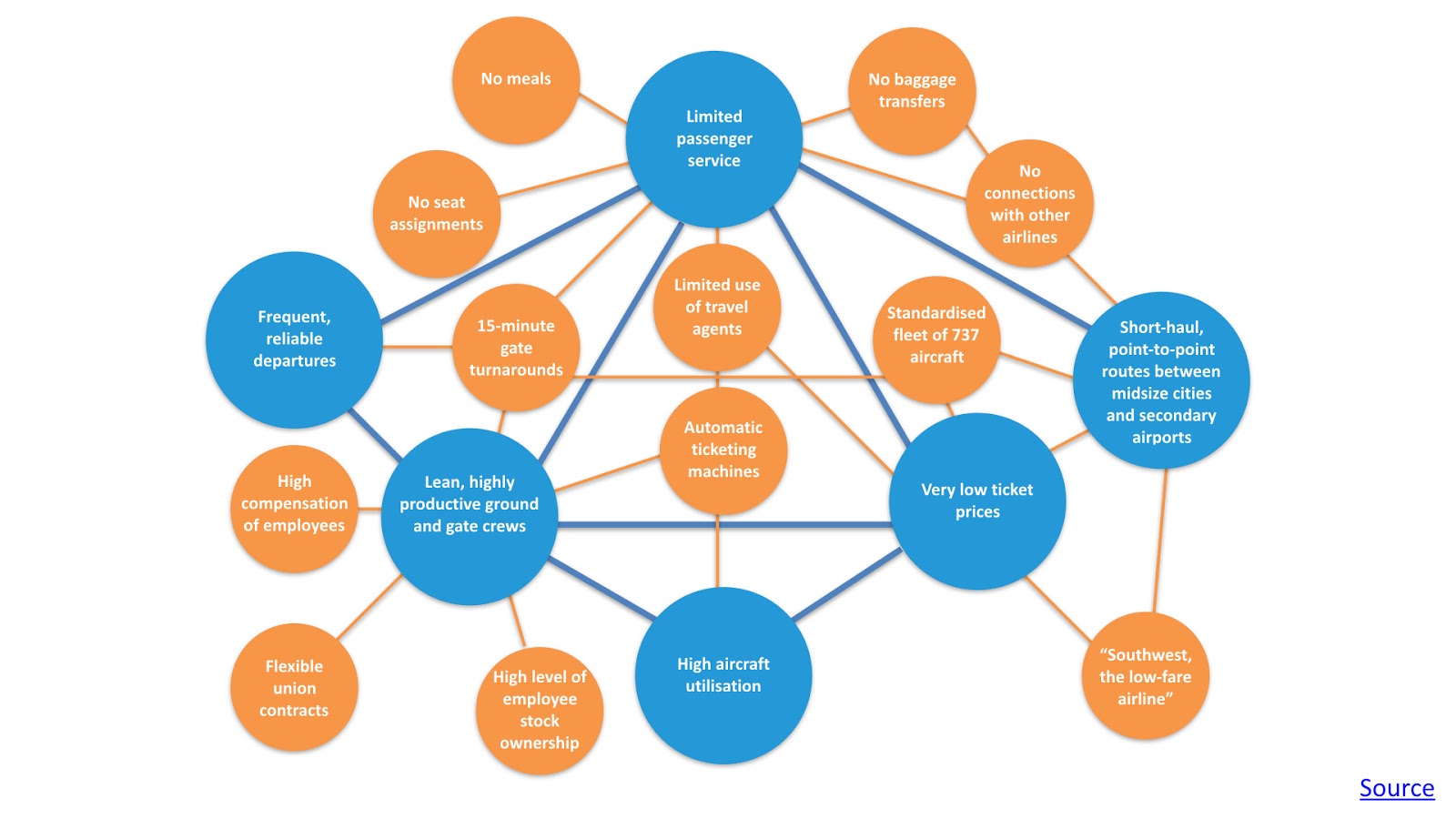
Click to open a larger version in a new tab
The more stable the compound, the slower it reacts
A stable compound with lots of bonds, while strong and hard to copy, is slow to adapt if the market changes unexpectedly. Change forces managers to dismantle their existing resource systems and reassemble them in new strategic positions.
“For example, Liz Claiboe, an apparel company, relied on a positioning strategy in which production, distribution, marketing, design, presentation and sales resources were all tightly linked. But when the industry changed, the company’s relationships with department stores were disrupted. In an effort to adapt, Claiboe executives changed resources such as their “no reordering” process that had antagonized department stores. But since this process was synergistically entwined with other resources like overseas logistics and distant manufacturing locations, the “no reordering” process could not be undone without damaging system coherence. Financial performance sank precipitously. Only after Claiboe executives dismantled their existing resources and started recoecting new ones did positive performance begin to retu.”
– Source
All of the above is to say that the key to an effective and sustainable strategy is to focus on the integration of activities. Operational efficiency alone isn’t a strategy. A good way to sanity-check this is by asking why you're doing an activity.
I like this slide from fellow Distiller Rob Ousbey, which puts some of theory into context in marketing strategy:
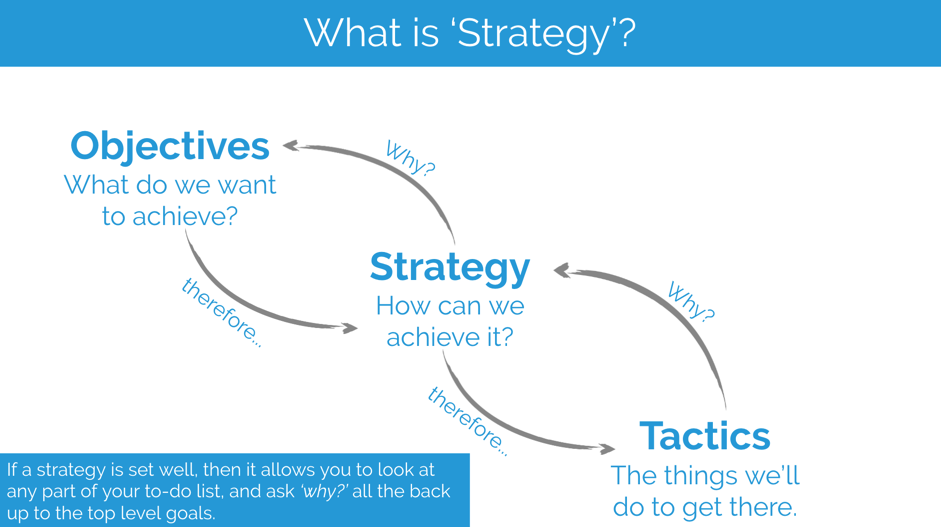
Making marketing strategy easier
What type of strategy do you need?
Start here:
The type of marketing strategy you use can (and should) change as the business requirements change. Two questions that are a good place to start:
- How predictable is your market?
- How malleable is the market (can you influence demand, needs, etc.)?
Based on your answers to those questions, there are choices. I like the wording from “Which Strategy When?”:
- Position (fortress) – Positional-based strategies are best when you're trying to defend a long-term position in the market. Strategies in this space involve deepening the activities and resources that you have within a particular area. This is best in markets where there isn’t a lot of change.
- Leveraging strategy – Leveraging strategies are useful in markets where you have some influence on how the market moves and there's less predictability. A chess analogy is a good one, since it’s not just about having the right pieces; it also requires making smart moves. A recent example that I love is the example of Google using Deepmind AI to reduce data center costs by 15%. That’s a pretty big deal.
- Opportunity (surfing) – Opportunity strategies can be compared to surfing and waves; it’s hard to predict when they'll come or how long they'll last. Timing is important, and occasionally you get a good one. Being set up in a way that allows you to capitalize on opportunities as they arise is crucial.
It’s possible, probably recommended, to have some mix of all three. I like the graph that our R&D team use to explain this, shown below. The idea is that there are always trade-offs between the chance of success and reward.
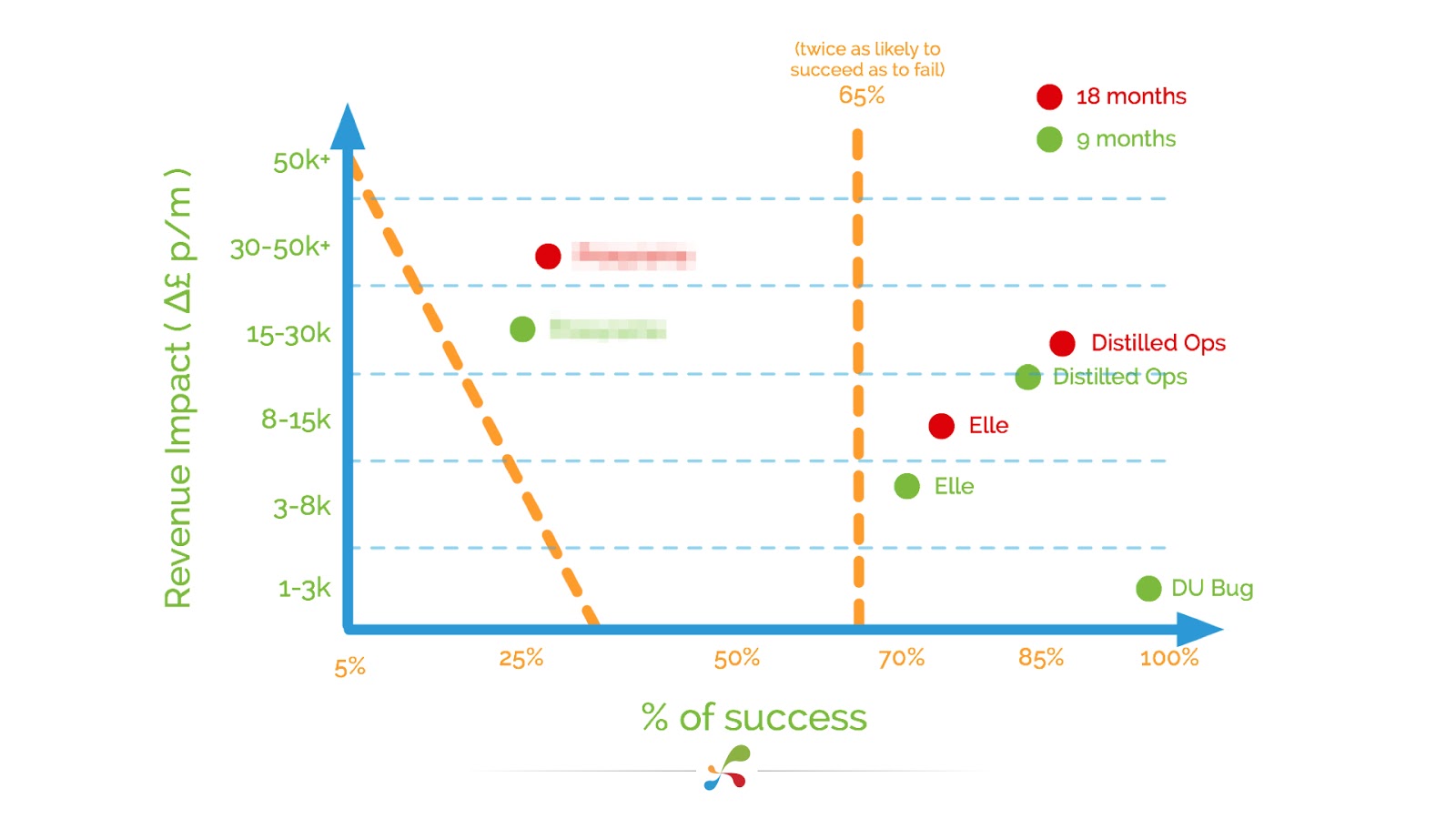
Click to open a bigger version in a new tab
Picking a strategy and making decisions
Start here:
Closely related to the difficulty of strategy is the necessity to make choices. Strategy forces you to make decisions and explicitly cut off options. This can be difficult for a number of reasons. I talked about this in depth in my SearchLove Boston presentation, Creating a Digital Strategy:

One of the hardest things about strategy? Resisting the urge to do it all. The most obvious way this happens is by getting distracted by competitors. In the book The Secrets of Consulting, the first chapter introduces the idea of the law of strawberry jam: "the wider you spread it, the thier it gets,” which is a nice way of saying that you can’t do it all. Every service or feature you add to your business has a cost of some kind. Trade-offs are a critical part of making sure your strategy is sustainable, because they protect from competitors trying to straddle multiple markets.
To go back to the previous example of Southwest Airlines, someone that tried to spread it far and thick was Continental Lite. By trying to copy Southwest and offer a low-cost airline solution while still trying to compete as a full-service airline:
“The airline dubbed the new service Continental Lite. It eliminated meals and first-class service, increased departure frequency, lowered fares, and shortened tuaround time at the gate. Because Continental remained a full-service airline on other routes, it continued to use travel agents and its mixed fleet of planes and to provide baggage checking and seat assignments.”
Source: What is Strategy?
If you haven’t made some trade-offs, your position probably isn’t sustainable and is open to imitation.
“Trade-offs ultimately grounded Continental Lite. The airline lost hundreds of millions of dollars, and the CEO lost his job. Its planes were delayed leaving congested hub cities or slowed at the gate by baggage transfers. Late flights and cancellations generated a thousand complaints a day. Continental Lite could not afford to compete on price and still pay standard travel-agent commissions, but neither could it do without agents for its full-service business. The airline compromised by cutting commissions for all Continental flights across the board. Similarly, it could not afford to offer the same frequent-flier benefits to travelers paying the much lower ticket prices for Lite service. It compromised again by lowering the rewards of Continental’s entire frequent-flier program. The results: angry travel agents and full-service customers.”
Source: What is Strategy?
Other academic theories as to why copying competitors is a bad idea are covered in the Iovator's Dilemma, which I also recommend reading.
The short version is that when competitors copy each other, the only person that wins is the customer. Over the long term, the more competitors converge, the more they look like each other and customers default to price to help choose between options. This drives prices down and squeezes margins.
To draw comparisons to the search space, I see this taking place in processes like keyword research. So many companies make a big list of keywords, then chu out average content that looks the same as every other article online about that topic. Don’t waste your time.
Advice for choosing a digital marketing strategy
Start here:
Don’t tu it into an optimization problem. There's more than one right answer in the majority of cases. I like the advice Scott McNealy gives (he was a co-founder of Sun Microsystems and its CEO for 22 years). When asked how he makes decisions, he said:
“It’s important to make good decisions. But I spend much less time and energy worrying about 'making the right decision' and much more time and energy ensuring that any decision I make tus out right.”
Source
What an amazing attitude! You can see how this applies at the later stage in strategy. Once you’ve gone through all of the possible scenarios, validated the ideas, and narrowed it down to the last couple, this is the stage where analysis paralysis takes effect and people naturally want to tu strategy into plaing. Just pick one and focus on making sure it tus out a success. Another way to think about this: strategy is about placing bets and shortening odds of success. Remember that you can course-correct; strategy isn’t sniping. You can take more than one shot and iterate, so don’t be afraid to change.
With that in mind, I’ll wrap it up. Hopefully this was useful to some people. For a deeper dive into this, take a look at my SearchLove presentation, Creating Your Digital Strategy, which covers all of the above and in a more practical, process-driven way.
برچسب:
نویسنده: moz
What's more important: drawing in more traffic, or converting the traffic you have? When it comes to your landing pages, that may be a tough question to answer. After watching today's Whiteboard Friday, you'll be better equipped to decide whether your site should opt for an SEO focus, a conversion focus, or a strategic balance of both.

Click on the whiteboard image above to open a high-resolution version in a new tab!
Video Transcription
Howdy, Moz fans, and welcome to another edition of Whiteboard Friday. This week we're going to chat about landing pages and conversion-focused landing pages versus SEO-focused landing pages.
So a few weeks back, I was at Unbounce's CTA Conference up in Vancouver, Canada, which was an amazing event, one of the best conferences that's put on in our industry, in my opinion. I got a question from a few folks there about how to decide whether to target a landing page toward SEO, toward conversion rate optimization and conversion-focused, or whether we could combine those. So I thought we'd chat a little bit about that today. It is quite doable.

An SEO-focused landing page has a few features that are unique from a conversion-focused landing page. In fact, both of them are unique. So what I'm going to do is use the example of Little Hotelier. Little Hotelier offers reservation software, front desk software for small hotels, B2Bs, guesthouses. I thought we could imagine basically a resource page on their website that was really a landing page that's focused on SEO around a hotel booking site database. So, of course, one of the things you have to do if you're a small hotel, or a B2B, or a guesthouse is you've got to get listed on hundreds if not thousands of different listing sites — Booking.com, Expedia, Travelocity, Kayak, etc., etc., all the way down the list, down to the very local-focused ones or regional-focused ones.
Managing all those listings is a real pain. So is managing the front desk and the bookings and making sure that everything is convenient. So Little Hotelier manages all this for us and has a resource page. It's not quite as good as the one I'm going to describe here. But let's just imagine for a sec that they have this list of all the hotel booking sites, a database of it with all the information you might want. Then, of course, they have their conversion-focused page, littlehotelier.com, their homepage, which is really all-in-one business software for B&Bs, and guesthouses and small hotels. This is very conversion-focused. They're trying directly to get people to buy the product.
This page is much more resource-focused. They're trying to get people to see, "Hey, here are all of those sites that, well, of course, Little Hotelier can help list you on and manage for you, but also here's just generic and general information about them." I think it'd be awesome if they listed all of these sites and included things like traffic and the number of bookings that they saw from those sites in 2015, the requirements to get listed, and the submission page. Then they could have a CTA, a call to action like, "Let Little Hotelier manage hotel bookings for your property."
This would work really as an SEO-focused landing page. It's designed to draw traffic in, to drive keywords like "list of hotel booking sites," "where to submit my small hotel," "most visited hotel booking sites." You could even make regional-focused ones of this, like "hotel listing sites New Zealand" if they wanted to have a New Zealand-focused set of sites where you could submit or manage yourself in the booking world. This one is really much more targeted, hypertargeted, only focused on the keywords that are going to convert people directly, like "small hotel software" or "B&B hotel reservation software," that kind of stuff.
The differences and identifying your needs
The differences between these two and the way to identify whether you need one or the other or need a mix of them is to ask a few questions. First off:
- Are you trying to rank for generic keywords or conversion-focused keywords?
- Are you trying to rank for both?
- Are you not worried about keyword rankings at all and you're only conceed with conversion?
If you're only conceed with conversion, then you want this one. But if you are worried about both ranking for keywords and trying to convert some visitors, you probably want a more content-focused page like this one, a more SEO-focused landing page.
Bounce rate and engagement rate
One of the needs that you have with SEO is that you need low bounce rate and high engagement rate. But the reverse is true here. You don't necessarily need to worry about bounce rate, engagement rate, you only need to worry about conversion rate.
SEO-focused: So this needs a low bounce rate and a high click-through rate. You want people staying on this page, you want them to click the call to action, and you want them to investigate more.
Conversion-focused: But on this page, actually a high bounce rate is okay if the conversion rate is high. So if people are converting from this page, it doesn't matter too much if a lot of people visit and many of them go away from here. That's not too important to you. You're just worried about conversion rate and optimizing for that conversion rate. If you can bring that up a percent, you don't mind if bounce rate also goes up 5% or 6% or 7% because you're tuing people off who are the wrong customers.
Keyword targeting
SEO-focused: Here, you've got to have keyword-targeted content. That means the content itself needs to fulfill all the requirements that Google has and that visitors have around what they're looking for.
Conversion-focused: This, keyword targeting is secondary or might even be uecessary entirely.
Editorial links
SEO-focused: This needs to be able to ea editorial links or it can't rank. If it can't ea editorial links, it's going to have a very, very difficult time with manual link building to a conversion-focused page. Commercially-focused pages are much tougher.
Conversion-focused: But this one doesn't even need to worry about links at all.
Audience
SEO-focused: This one has to serve many audiences. It's treated really like a piece of content that helps anyone who's looking for this information and then has a CTA, a call to action on the page.
Conversion-focused: But this one needs to be heavily focused on one particular audience, the particular audience Little Hotelier is trying to convert who's the right customer for them, for their software. Hopefully, those folks are already qualified.
SEO-focused: These folks over here are not necessarily qualified. This might be part of the qualification process. If you visit this page and you then say, "Huh, I'm kind of interested in letting them manage my bookings," maybe you should end up here, on this landing page that is conversion-focused.
Traffic
SEO-focused: This page should be driving traffic to those more conversion rate-focused pages.
Conversion-focused: This page, yes, it might rank for some keywords, but it's primarily conceed with direct conversions, and hopefully it's receiving traffic from other onsite chaels, like this one, or offsite paid chaels that are driving very targeted visitors.
What I'd urge you to do is ask yourself these questions when you're considering a landing page. Am I trying to ea traffic that might be interested in my content? If so, you're building one of these (SEO-focused). If you're trying to target an audience that is already qualified, that's already familiar with you, or that you're trying to get familiar with your product, then you're really trying to convert them, in which case you want one of these (conversion-focused).
Conversion-focused: These pages are great for doing tons of landing page testing and optimization. They're great for videos. They're great for testimonials.
SEO-focused: These types of pages are great for content. They're great for serving all sorts of visitor intense. They're great for targeting a large set of keywords that all have the same searcher intent.
When you try and mix these, things get a little challenging. That's where you really need to balance out and decide: "Hey, what is my primary goal here? Serve the searcher audience, which may not be conversion-focused, or convert people and not worry so much about the searcher audience. Maybe try to capture them on other pages before they get here."
All right, everyone, look forward to your Idea, and we'll see you again next week for another edition of Whiteboard Friday. Take care.
Video transcription by Speechpad.com
برچسب:
نویسنده: moz

When it comes to brick-and-mortar storefronts, local businesses often struggle to compete with neighboring big brands. Statistics show that, even for a well-known local store that's established a strong relationship with its customers and built a community through the years, having such a neighbor can be detrimental. But what about a newly opened business? Does it have any chance of competing with popular brands? My experience has led me to believe there's only one way a locally owned business can overcome big competition: it needs to take advantage of local SEO.
Recently, in collaboration with Accuranker, I conducted a survey that touches upon the difficulties local businesses face when trying to become visible in Google’s local results. We analyzed more than 300,000 local SERPs across multiple industries (beauty, medical services, auto services, legal, shopping, etc.) to get a clear understanding of what the chances are for a local site to seem attractive to Google.
One of the more curious insights our research revealed is that the legal services niche is among the most competitive. Sure, this finding isn't rocket science. In fact, I bet on some level you were aware of this (or at least you had a gut feeling). However, this issue is much more complex than it seems. The legal services niche far surpasses other niches in terms of competition and prices.
Does this mean that the legal services niche falls under radically different rules and requires unique SEO tactics? This is exactly the question I set out to answer, and you’re most welcome to follow me on my little investigation!
Gathering the data for this article
After reading this article, you’ll understand the biggest challenges that any legal website faces when trying to become visible in the SERPs. The data here will help ensure that your future strategies are based on informed decisions. Moreover, you’ll be able to streamline your creative process and find non-standard approaches that will cement your success in the legal industry.
To conduct proper research on what SEO strategies local businesses employ in the legal services niche, I took the following steps:
- I made a list of keywords unrelated to any brand (which could hardly be classified as local).
- I identified the most competitive places in the US for this industry in order to analyze how legal sites build a presence in this extremely aggressive environment
The first step was simply to do keyword research, which involved a bit more manual work than usual — I tried my best to filter out branded keywords and ones that weren’t relevant to local searches.
With the help of Statista I was able to get a list of the states in America that have the highest employment rates in the legal niche:

This graph shows US states with the highest number of employees in legal occupations in the United States as of May 2014. Source: statista.com
You can see that Califoia, New York, and Florida have the highest number of employees in this industry, hence these locations are the most "densely populated" by law firms and lawyers, and, as a result, the competition in these states should be higher than in other states. After I made a list of the most competitive locations, I was ready to move on to the next step — analyzing the domains that appear in SERPs for the keywords I had previously selected.
Now let's see what my findings revealed.
The top 5 SEO challenges for the legal niche
The extreme competitiveness of the legal services niche might be explained by the fact that this market generates more than $248 billion USD in revenue (according to a recent report provided by Statista) with only a relatively small number of searches.
To give you a better understanding of the size of the legal services industry in the US, let’s compare it with a bigger market: for instance, if we look at ecommerce, we can clearly see that the revenues generated by the two niches in question are nearly the same (ecommerce sales surpass $256 billion USD), despite the fact that ecommerce traffic share figures are four times greater than in legal services. It’s safe to say that the legal niche has tued out to be a ridiculously competitive market, because it's an outrageously profitable one. I’m also certain that the success of any SEO activity depends on a deep understanding of how the industry and its major players work.
In the next section, you’ll lea about the main challenges that legal businesses face.
#1. Online legal business are dominating local SERPs
Statistics from an IbisWorld report confirm that the online legal services niche was able to generate $4 billion USD in 2015. Moreover, in recent years this niche has been steadily expanding due to the fact that consumers are interested in getting legal services online. That’s why it doesn’t come as a surprise that a company named Rocket Lawyer generates more than 30,000 searches monthly (according to Google Keyword Plaer) by helping users deal with their legal issues online. This number of searches proves that online legal services are gradually becoming popular, and people don’t want to spend their time scheduling an appointment with a lawyer anymore.
Now you’re probably wondering how this trend is affecting local SEO, right?
Knowing that New York, Miami, and Los Angeles are among the most competitive locations for the legal niche, I decided to find out which sites are the most visible in local search results there. I took into account more than 500 different keywords related to legal services and compiled a list of the domains that most appeared most frequently for those keywords. And here are the top three domains that remain visible in local search results in all three cities:
- Findlaw.com
- Avvo.com
- Lawyers.com
After making this list, I double-checked these websites to make sure that all of them belong to the online legal services niche. I also decided to dig deeper and manually checked the top twenty domains that were most visible across all the locations I analyzed, in order to understand what kind of legal services they provide. I found out that 55.6 percent of the sites I analyzed belong to the online legal services niche. That means that local businesses now have to compete not only with global businesses, but also with online legal businesses that, by default, have better positions in SERPs, as the main goal of their business is to increase their online presence by getting more organic traffic from Google.
#2. Google doesn’t give priority to local legal businesses in organic search results
Apart from the strong presence of online businesses in local organic SERPs, I was struck with the steady visibility of the top twenty websites that appear in local search results in New York, Los Angeles and Miami. The shocking truth I discovered about Google local SERPs is that less than 20 percent of sites were unique across all the studied locations. This means that search results are occupied by global and online businesses in 80 percent of cases. Furthermore, the top three most visible domains remain the same in all three cities, and they are as follows:
- Findlaw.com,
- Avvo.com, and
- Lawyers.com.
I also discovered that all three of these websites belong to the online legal services niche, and, despite SEO visibility, have a good number of backlinks. I am of the opinion that local businesses have no chance of competing with them whatsoever.
As I studied the 20 percent of websites that are unique, two curious cases of locally based businesses caught my eye — Injurylawyers.com and Cellinoandbaes.com. Let’s take a closer look at these two websites.
From Injurylawyers.com’s “Contact” page, I leaed that it operates mostly in Florida. However, I don’t think that the reason it ranks so highly in local search results in Miami is because of its physical presence there. Even at a quick glance, it becomes clear that Injurylawayers.com is ranking so high in local results because of its website’s overall performance. As you can see from the screenshot below, its website has a good number of referring domains, as well as a decent amount of organic traffic:

Source: ahrefs.com
Another site that caught my attention — Cellinoandbaes.com — has a branch based in New York. The history of this legal company begins over 50 years ago, and without any doubt Cellino and Baes is a well-known and trusted bran. Plus, Google recognizes it as a brand. The very fact that its brand name is being searched for more than 6,000 times a month speaks volumes about the trustworthiness of this legal company:

All these facts show that Cellinoandbaes.com’s visibility in New York SERPs is because of the domain’s general performance in Google US organic search results:

Source: spyfu.com
My quick research proves that, in practice, Google doesn’t give priority to NY-based legal companies and still mostly relies on general ranking factors. And it seems obvious now that any online business can easily outperform an offline SMB legal company by increasing the number of backlinks, brand mentions, and site visits it receives.
#3. The local pack is still a saving grace for local businesses
One year ago, Google implemented a major change that dramatically minimized local businesses’ chances of becoming visible in local packs: Google replaced the 7-pack in SERPs with a 3-pack. And I was quite interested to figure out what kinds of businesses now hold these three positions in the legal niche, and whether these results are local.
Despite the fact that local organic SERPs are fully occupied by big online businesses, the local pack still is the best way to remain present in Google for locally based legal companies. My research revealed that 67 percent of sites that appear in local packs for legal services are hyper-local and local. To arrive at this percentage, I analyzed the domains that appear in local packs in New York, Miami, and Los Angeles in terms of their SEO performance in Google US (to do this, I used Serpstat’s Batch analysis tool).
I was also curious what share of online presence the local legal businesses that appeared in the local pack had, along with the breakdown by states. To mark sites as local, I checked their their traffic with the help of the Serpstat's Batch Analysis Tool. (I'd like to note that I find Serpstat’s figures most relevant for such purposes, as they parse raw data from Google US. You can easily spot which sites are global and which are local.) And here’s what I found:
- Miami – 60% of legal websites appear in the local pack
- Los Angeles – 35% of legal websites appear in the local pack
- New York – 15% of legal websites appear in the local pack

This was quite an insight, since I assumed that Califoia would be the most competitive location for the legal niche, because — as you may recall from the begiing of this post — it's the state most densely populated by law firms. Also, it’s surprising to find New York only at third place in this list. Yet, as you can see, Miami has the greatest number of local sites that are present in local pack. Therefore, I believe that being featured in local search results in New York requires a lot more resources than it does to achieve the same visibility in Miami. And this is something that every SEO expert should be aware of.
#4. You can’t stand out without a site — even in local pack results
It’s a well-known fact that Google’s local pack provides businesses with the opportunity to appear at the top of Google SERPs even without a website. According to my previous research, which I conducted in collaboration with the AccuRanker team, the local pack works much better for less competitive niches. What I tried to clarify here is whether you can stand out in a local pack without a website in such an unconventional and competitive niche as legal services. Unfortunately, no, you caot.
To prove this, I analyzed 986 local SERPs in order to figure out if legal brands can appear with or without a website. My findings showed that 86 percent of legal businesses that pop up in local packs have a website. This means that even if your business is visible in local packs without a website, in a majority of cases, it’ll be considered by potential clients as less trustworthy, since users usually expect to see a link to a particular domain.
Without a link to a professional-looking website, your business will seem less credible — not only to potential clients, but also to Google. Nevertheless, it’s not unusual for large, global companies to be trusted more than small, local ones. Therefore, small companies need to instill confidence in their potential clients by having a website.
#5. There’s no correlation between a legal website’s ranking number one in a local pack and its number of reviews
I’m certain that every business owner understands the importance of customer reviews. It’s a no-brainer that a level of trust is instantly established when a potential client sees that a local business has reviews. And it definitely increases the likelihood of said client to convert. Also, the very presence of Google native reviews is thought to be among the Top 50 local search ranking factors.
However, this study of legal services has already revealed that there are quite a few peculiar ranking factors that business owners need to keep in mind in order to succeed in this niche. That’s why I was curious to know whether there’s any correlation between a site’s number of customer reviews and its ranking #1 in a local pack.
With the help of the AccuRanker team I was able to get the sum of reviews that show beside each result in local pack. Afterwards, I analyzed more than 2,000 local SERPs in New York, Los Angeles, and Miami. And here’s what I found:
There’s no correlation between ranking in the first position in a local pack and your number of reviews.
For instance, in New York local pack results, the companies that appear in the third position have 824 total reviews. Those that appear in the first – 732. Moreover, I noticed a good number of cases in which a company that had a solid number of reviews was ranked in the third position, while a business that hadn’t even been reviewed yet was ranked in the first.
Another striking insight I gained: most legal sites never show their potential visitors more than 2 reviews. Based on this data, I can say that this represents an overall industry trend of a lack of native Google reviews. That’s why Google ranks businesses that haven’t been reviewed so highly. Even if you have a significant number of customer reviews, it won’t help your business rank higher in local pack results.
One final note
Without any doubt, the legal niche presents a lot of unique local SEO challenges that other industries hardly ever face. The high penetration of online legal services into the existing legal market is changing the current business landscape — in particular, it's drastically affecting local results. Online legal businesses are stealing an outrageous amount of web traffic from local companies, without giving them even a slim chance of ranking as well in local SERPs.
Fortunately, local legal businesses still have priority in local packs, but the highly competitive environment is forcing them to improve their online presence by creating a website. Since a majority of the companies that appear in local packs have sites, your potential clients’ expectations are ratcheting up. In fact, this trend may reinforce searchers' opinions that businesses without a website are untrustworthy. Furthermore, it seems that Google also prefers to show users local legal businesses that have a site, rather than those that don’t. The only good news is that your number of reviews doesn’t really influence your rankings in local packs.
Still, if a local legal business is interested in attracting clients via the Inteet, it shouldn’t hesitate to look for alteative ways of generating traffic in both organic and paid search chaels.
برچسب:
نویسنده: moz
Are you ready for AMP? Ready or not, it's coming to Google search results, and it's arriving in a big way. Google has aounced that they'll be showing Accelerated Mobile Pages in their search results for the “ten blue links.”
This means that sites that aren’t news-specific now have the opportunity to show AMP pages in Google’s search results.
AMP is a very lightweight version of a webpage that has been stripped of the many elements that cause a regular webpage to display slowly, such as tons of cookies, third-party Javascript, and slow-loading ad networks. This results in a page that loads lightning-fast, which is great for those who are on slower coections or simply don't want to wait for a regular, heavier page to load.
AMP has had a fairly positive reception both from site owners and from users. It's much faster and more streamlined for searchers, especially on mobile devices that tend to be a little bit slower coection-wise.
Not a ranking boost
It's important to note that AMP pages in the mobile search results do not receive an additional ranking boost. Google currently has the mobile-friendly ranking boost, and because AMP pages are mobile-friendly, they receive the same ranking boost.
There isn't an additional incentivized reason to use AMP strictly for ranking purposes. Don’t switch everything to AMP simply because you think you’ll get an additional ranking boost to help you beat out competitors.
There are indirect ranking benefits, though. For example, if searchers seek out AMP results, some sites could see higher clickthrough rates on their AMP pages. And as consumer awareness grows about AMP, that will likely rise.
Replacing mobile results
Google isn't showing additional search results based on AMP specifically. Sites with AMP won’t show two versions of the same page in the search results, one mobile and one AMP. Rather, if any of the pages in the SERPs have an AMP version, Google will show that instead of the mobile or desktop page that would normally appear.
Just as a mobile-friendly page has a tag at the front of the description snippet showing that it's mobile-friendly, AMP has the same thing. For AMP, those results are tagged with AMP and an encircled lightning bolt before the description.

Will you be penalized for not displaying AMP?
No, Google is not plaing to penalize a site simply because it isn’t AMP. Your site will still have the same positioning in mobile search results as the mobile version of the page.
Google will simply replace the mobile-friendly page — or the desktop page, if a mobile-specific page isn't available — and show the AMP version of the page.
For sites that don't have an AMP version of their page in the SERPs, Google will opt to show the mobile-friendly page first, or the desktop page if there's no mobile-friendly version. But sites that are AMP-less will not be demoted in any way.
Do other ranking factors apply to AMP?
There's no reason to believe that some of the regular ranking factors wouldn’t apply to AMP pages, especially for those websites that are currently AMP-only. However, because of the nature of AMP, they likely wouldn’t be a conce.
This will include things like page speed. Because AMP pages are significantly faster than mobile pages, there’s no reason for a site owner to worry that they could be negatively impacted in rankings because of slow page speed.
Likewise, with the above-the-fold algorithm that targets sites with significant ads above the content, this again isn’t cause for conce as most AMP pages are “ad-light.”
But it is important to remember that while Google is crawling the mobile version and AMP version of pages, rankings are based on the desktop page. Thus, faults with the desktop page — such as slow page speed — could impact the overall performance of your AMP page positioning.
Should sites ditch their mobile version for AMP?
This question is going to become a bit more interesting as this rolls out to the 10 blue links. There are sites that are currently only available in AMP, such as the AMP Project website itself. But with Google now showing the AMP version in place of the mobile version, should site owners be conceed about having a mobile site?
Well, as of now, this is a Google AMP initiative. Other search engines haven’t aounced the use of AMP in their own search results. First you'll need to consider whether other search engines have issues with sites that are AMP-only — for reference, Bing has no problems indexing AMP-only sites.
Another consideration is that AMP pages are definitely more bare-bones than your typical mobile page. You need to look at it from a user-experience point of view. Are there elements on a page that will negatively impact your customer's experience if they're not displayed on AMP?
Also, look at it from a resource perspective. For sites that maintain a separate m.site already, maintaining three versions of the page could be impactful from a resource and work hours perspective. This won’t be as much of a conce for those using responsive design, since changes made to desktop automatically get rolled out to the mobile version.
Will users gravitate to AMP results?
Just as many searchers gravitate towards search results that are tagged "mobile-friendly," it's very likely that some searchers, especially those on slower coections or those conceed about their data usage, will gravitate to those results that are in AMP format.
Also, because AMP pages tend to be less ad-heavy when compared to their mobile counterparts, some prefer AMP for this reason alone.
How popular is AMP?
At Google I/O, Google revealed that it has more than 150 million AMP documents indexed in their search results. And those documents are coming from 650,000 domains.
Many new sites are getting on board with AMP daily, and many large sites have added AMP pages to their entire website.
Is it country-specific?
Google is still rolling out AMP in the news carousel inteationally. When AMP rolls out in the "ten blue links," it will be an inteational launch. So even if your country isn't currently showing AMP in the news section of the search results, AMP will show in the main search results when this goes live.
Is it live now?
No, this isn’t pushed live in the SERPs right now. Google has not said precisely when this will happen, other than they'll be making “this feature more broadly available later this year.”
Google notes that they've delayed this launch to allow sites time to implement Accelerated Mobile Pages before it goes live for all results. Because of AMP being so new and due to the leaing curve involved, pre-aouncing the change is particularly welcome in this case.
Ecommerce sites
Ecommerce sites can effectively implement AMP, and many have successfully done so in preparation for the suspected launch. But with no specific timeline for when it’s going live, there's a good chance this could go live in time for the upcoming holiday shopping season.
At the very least, ecommerce sites should make sure their content pages are AMP-ready. It doesn’t seem as though the various shopping carts have made their software or plug-ins AMP-friendly yet. But I expect that, on the heels of Google's aouncement, they're scrambling to make their carts (or at the very least the product pages created through the cart software) AMP-friendly.
How to view AMP in search results
Google is only showing this to searchers who search through the Google AMP Demo URL, which can be accessed at g.co/ampdemo.
The demo shows how Google currently plans to display AMP in the search results, although Google could change the appearance before the official launch goes live in the SERPs.
Tracking AMP analytics
For those who have yet to set it up, Google does include information about AMP in their search analytics. You can drill down and see the specific keywords, positioning, clicks, and more just for AMP alone.
To find it, login to Search Console, click on Search Traffic, then Search Analytics. Undeeath “Search Appearance” you can select “AMP.” Now you can drill down into AMP by pages, queries, etc. to lea more about how your AMP pages are seen and performing in search.
Setting up AMP
For those that are using a popular CMS such as WordPress or Joomla, there are already plug-ins to convert pages into AMP format. This makes it very easy for websites to make their websites AMP-enabled for searchers looking for AMP specifically.
Baby-step your way into AMP
You don't have to implement AMP across the entire site at once. You can choose to test it out on a few pages first, or convert sections at a time so the errors are less daunting. Those errors would also be cleaned up as you roll out the next section of the site to AMP.
AMP errors
It can take up to a week or so for AMPs to show up in Google Search Console, so it's important that you go back and check which AMP errors show up on your site. There are some common errors, usually related to markup used in themes or missing logos, but Google’s help documents are fairly intuitive.
Google shows AMP errors on a per-page basis in their Google Search Console error reporting. And until these errors are fixed, those particular pages will not show AMP in the search results. The pages that are error-free will show. Site owners can correct the most widespread or significant errors first, then tackle the individual pages with errors.
AMP errors also show up on individual pages for specific elements on the page, such as where you might have embedded video or other elements that are not AMP-friendly.
You can find AMP errors, along with the number of indexed AMP pages, in the AMP section (within the Search Appearance section) of Google Search Console.
Google also has an AMP validator available.
Advertising on AMP pages
For those site owners conceed about loss of revenue, there are ad networks that comply with the AMP standards and can be used on your AMP pages.
The AMP Project maintains an extensive list of supported ad networks, including the most popular ones (AdSense, DoubleClick, and OpenX).
Social sharing & AMP
One of the newer features that Google has added to AMP is the ability to include share buttons for various social media platforms. Some site owners were reluctant to lose the potential for shares, since many sites derive a significant portion of their traffic this way.
The <AMP-SOCIAL-SHARE> tag doesn't yet support all social media platforms, but it supports the most popular ones (such as Facebook, Twitter, Pinterest, and Google+).
Checking for AMP validation
There's a great extension for Chrome that will show you if an AMP validates properly, as well as show you any webpage that has an AMP version available. This is pretty handy if you need to do competitive research and wish to lea more about the pages or types of pages that your competitors have AMP enabled for.
The lightning bolt will appear green for a page that is AMP, and it will show blue with a link to tell you that an AMP version of the page is available. Just click it to view the page as AMP instead.
This extension also enables you to view the page from a desktop computer. Right now, the Google AMP demo requires you to use it from a mobile device, which isn't ideal for those looking at AMP from a site-owner perspective.
Getting help with AMP
Google also has an AMP support forum on the Google Webmaster Help forums for site owners ruing into any issues implementing AMP or getting it indexed properly. Multiple AMP experts regularly post in the forum answering questions and troubleshooting.
AMP resources
Suddenly find yourself having to get up to speed with AMP and don’t know where to start? Here are some useful industry resources.
برچسب:
نویسنده: moz

Researchers estimate that it’s up to 25 times more expensive for a company to acquire a new customer than to keep an existing one, making ongoing investments in consumer satisfaction a priority. There's nothing more disheartening to a local business owner than receiving a very negative review — and given that as little as 13% of consumers will patronize a business with a 1- or 2-star rating, there may be nothing more important than the owner taking every possible step to resolve negative reviews with speed and skill.
Negative reviews don’t write themselves. While looking at restaurant reviews recently, I came across an owner-consumer interaction that perfectly encapsulates the typical steps that take a transaction from bad to worse. It serves as a diagram of how these costly scenarios begin, proceed, and escalate, ultimately resulting in permanent damage to the company’s reputation.
The blame isn’t one-sided, and my goal here isn't to make the customer or the owner out to be "the villain." Rather, I'd like to point out key elements that actually worsen the situation, rather than improving it. Both owners and consumers sincerely want to feel satisfied, and the good news is that, in most cases, the only thing standing in the way of this is responsible communication.
Let’s take a look!

Image courtesy of Blake Patterson on Flickr.
The key to the "Food Truck Fiasco"

This story begins at a family-owned Philly Cheesesteak food truck that signed up to be a concession at a festival in the Southwest. One customer describes what happened on the day of the event this way, with my interpretation to the right:
 |
Key to Review |
|---|---|
| Grabbed "The Storm" (cheesesteak with green chiles) for $9 when they were parked outside the bike and brew festival. | Customer sets the scene for his story. |
| The woman told us it would take 20 minutes, but when we arrived back it took at least an additional 15 minutes to get our food. I'm sorry, but 45 minutes wait for a sandwich simply isn't acceptable. The sandwich was super small for the price, I could've eaten 3 of these things easy and I'm not a big person. I expect more for a $9 sandwich | The legitimate complaint in wait time, improper expectations being set, food portions, and pricing. These are honest grievances. |
| from a crappy concession trailer with zero overhead. | The revenge. Customer vents his disappointment with cutting, dismissive language. He insults the business. |
| EDIT: Like several other Yelpers, I had originally rated them higher, but reduced my rating after I received a nasty email from the owner shaming me for my feedback. Seriously, that is how you treat customers after making them wait 45 minutes for a super overpriced sandwich? If you can't handle honest feedback, then you should probably find another line of work. Keep it classy, [name removed]. | The worst possible outcome: owner's response leads to consumer editing his original review to dock stars and complain of a second bad interaction with the business. The customer is permanently lost, and the world is informed. |
The customer’s complaints are certainly understandable: he was honestly disappointed that it took so long for his food to be ready and then felt the portions were overpriced. It didn’t help matters that the staff over-promised and under-delivered in estimating the wait time. Up until this point, the consumer is blameless. But then he makes two mistakes:
- He makes no mention of voicing his complaints to the owner or staff in-person, at the time of service.
Upon receiving his small sandwich after 45 minutes of waiting, it would have taken him just one minute more to say, “I really want to speak the owner about this. I’m not happy with what just happened.” It’s the customer’s responsibility to speak up on his own behalf — to the let the owner know there is a problem for him to resolve. - Having failed to take on the responsibility of voicing his complaints directly to the owner at the time of service, the customer then vents his feelings to the world in the form of a negative review.
Not only this, but his remarks about a "crappy concession trailer" are mean-spirited, showing zero respect for the reality that this is, in fact, another human being’s livelihood. Being dismissive of someone’s job is uncivil, snobbish, rude, etc. Using language like this is unlikely to make friends, and is unlikely to bring out the best in the owner whom he is now, in fact, goading and insulting.
Regardless of the customer’s tone, the owner’s job is to be professional at all times. I’ve seen adept business owners handle even the rudest customers with a skill that leaves me in awe, but in this case, the owner of the food truck went down the worst possible road. Far from remedying the initial negative review, the owner’s response brought the customer back with further negativity, including taking off stars. Here’s how the owner responded (Eds. note: original spelling and grammar intact), with my interpretation on the right:
Owner's Response |
Key to Owner's Response |
|---|---|
| 5/23/2016 I'd have to say, I'm shocked and appalled at this "customers" behavior. However, if you look at his profile...it is really not all that shocking. Many businesses have felt the wrath of this poor shmuck. And just so everything is clear and on the table...I'm copying and pasting our so called "nasty" email we sent him. You can be the judge: | Calling your customer names and trying to shame him is the worst possible way to begin an owner response. |
| Hello, I am one of the owners of [business name removed]...along with my wife and father in-law. I just wanted to take a minute to help you understand the impact of your publicly posted criticisms. |
The owner's job is to apologize, not to correct or instruct the customer. |
| First, you should understand that we are an 8 by 16 truck that was inundated with 100's of orders all at once. Simply put, we did the best we could to get your sandwich out as fast as possible. With the space we have, grill size, etc...we can only do so much. | It is not the customer's job to be understanding about the business's limitations or problems. He expects to receive service. That is all. |
| We tried to be as honest and as accurate as possible with regards to wait time. As for the quality, we certainly want our customers to enjoy our food. This is why we cook to order, and try to maintain a level of freshness that other trucks may not. Given that you didn't like it, we would have preferred to have a chance to make the situation whole. However, you clearly chose not to afford us that opportunity. |
An explanation of the business's goal to provide quality product is good, but the real gem here is the owner's pain that the customer didn't complain in person. This is the owner's honest disappointment. |
| In regards to "no overhead." Well, that's just so far from accurate it made our heads spin. Perhaps consider: food costs (certified angus beef is not cheap), labor for our employee, propane, the generator rental fee ($200), the city temp license fee, the fire inspection fee, fees to do the event itself, the gas to tow and run the gene, water....I could go on, but hopefully you get the point. | The customer may be ignorant of how the business operates, but this is not the time to explain its costs. You haven't yet eaed the customer's friendship or empathy. He's going to walk for lack of an apology. |
| Lastly, on a more personal level, you should understand that we worked two 14 hour days for this event. We have a 10 month old son that was at his grandparents, suffered from great separation anxiety, a cried himself to sleep both nights. We finished cleaning at 1 am this moing only to wake up no your negative review about our "crappy food truck." | This is completely over the top. Customers do not want to hear about crying babies. They are paying for service, not sob stories. At the same time, the owner admits he's stung by rude language. This is real. |
| Overall, my ultimate goal with this note, is to help you better understand the impact of your words. And to understand that we are hard working people, who genuinely care about our business. When you are unhappy with a level of service, please, by all means, contact them privately and at least give them the opportunity to make the situation right. Criticizing them publicly gives them absolutely no chance to do that, creates a lasting stain on their hard work, and potentially takes food out of their children mouths. Had you contacted us, we would have offered you a free meal at our regular location or refunded your money. | The closing sums up how wrong and how right this owner's mindset is. He is totally wrong to believe the purpose of an owner response is to correct his customers. But, he's totally right that the lack of opportunity to respond well to an in-person complaint is a major pain point for his business, and millions of other businesses, too. |
Reading between the lines of the owner’s response, a picture emerges of a business that underestimated how busy it would be at an event and did not have adequate cooking facilities or staff to fulfill orders within a normal timeframe. This was the initial mistake that set the stage for all that transpired. Unfortunately, the owner then worsened the scenario by making the following additional mistakes:
- He confused his business with himself.
Leaing not to take business criticism personally is Reputation Management 101 for all owners and staff, and it can be the hardest instinctive mindset for anyone to overcome. If you’ve put your heart into your business, it is genuinely challenging not to view criticism as a personal attack … but you mustn’t get stuck there. You’re offering goods and services; paying customers expect to receive them. Business is transactional, not personal, and the customer is not signing up to hear about your fatigue or family problems. All this customer wanted was the sandwich he ordered. This is not personal. - He refused to accept responsibility for the customer’s bad experience.
The response peed by the owner is not an admission that the customer’s legitimate dissatisfaction stemmed from poor plaing or poor execution on the part of the business. The owner refuses to say, “My fault, I’m sorry.” - He failed to see the owner response function as his last chance to save a bad situation.
He views it as a place to justify himself by correcting the customer’s attitude, expectations, and sentiments. Once the negative review has already been published, the owner response function is likely the only life preserver left.Given the costliness of replacing a lost customer and the way a negative review can cost a company future business, the owner response field is not a platform for a lecture; it’s a platform for making the greatest possible effort to make amends.
- Finally, the owner devolved into personal insults, betraying a fundamental lack of professionalism.
A business is professional. A customer is just a person. Even if your customer caot utter a single sentence without using colorful expletives, professionals are meant to be trained to communicate in business-appropriate language at all times. What this owner has done is to reveal to the whole world that he refers to his customers in insulting terms if they have a complaint. Once anyone reads that, they know not to expect empathy if they encounter a problem with the business.
Perhaps the most powerful element of the owner response function is that it is not just for a single customer to read, but for all future customers to read. Respond well, and you may not only win a second chance with the customer, but also prove to all future potential customers that they will be treated with respect, empathy, and faiess by your company.
Crafting a powerful owner response

If the food truck owner were my client, this is a sample of how I would have helped him respond, with my key on the right:
Owner's Response |
Key to Owner's Response |
|---|---|
|
Dear Jim, I hope you can find it in your heart to accept my apology for the poor experience you had on the day of the event. This was totally my fault. |
Greet customer personally, if possible, and begin with a sincere apology. Take responsibility for your business, as its owner. |
|
I underestimated how swamped we would be and would have hired extra staff for the day if I'd realized 10,000 people were attending. This was our first time doing this event, and my failure to correctly predict the number of orders we'd be filling is what led to you waiting 45 minutes for your sandwich. I feel really bad thinking of you having to stand around waiting for your lunch when there was so much else to do at the festival. We make each sandwich fresh to order and my staff simply got inundated. |
Where possible, explain how the mistake happened. Validate the customer's experience by expressing empathy for their situation. Be accountable for any errors. |
|
I wish you'd had the chance to talk to me about this in person at the time, but I realize it may have been too hectic to reach out to me that day. I would gladly have given you a full refund or a free cheesesteak to try to make up for the inconvenience. Please, accept this as my invitation to stop by our regular location at 123 Main St. for a cheesesteak on me, where I promise you'll receive within our normal 10-minute timeframe. If you come, I'd really appreciate you taking a minute to let me know, in person, anything else you feel we can do to improve our food or service. This is our family business and we are so invested in serving our community well. |
Encourage all readers to believe that, if a problem occurs, you would love to have them speak directly to you or staff about it right at the time of service. Since the presence of the negative review means an in-person complaint likely never happened, offer an appropriate means of atonement and a guarantee of a better experience, if the customer will give you a second chance. |
|
Again, please accept my apology, Jim, and please give me a chance to make it right. Thank you, Bill Williams |
Close with a repeated expression of your sincere regret, your offer to make things right, and an identification of yourself as the owner of the business. |
Contrast the owner’s real response with this sample suggested response, and you are likely to come away with a completely different, more positive impression of the business. A few quick suggestions for coming across well:
- Keep length reasonable; don’t write a novel
- Beware of sounding like you’re on your high horse; use common, neighborly language
- Make sure you’ve apologized
- Where appropriate, explain what went wrong and describe any steps you’ve taken to correct an issue
- Extend your offer of something nice to try to make it better
- Welcome further feedback; it could lead to the reviewer updating their review with positive sentiment
Those are quick tips that should immediately help you to improve your reputation in the eyes of all who read your owner responses. Ready to dig deeper into developing a powerful, permanent mindset for all future tough transactions? Read on.
3 empowering tactics for better reputation management

Every business encounters criticism. Meet this reality better prepared with these three tips:
1. In business, we wear the mask.
When your spouse tells you're inattentive, when your friend points out that you chew with your mouth open, when your children berate you for not letting them adopt another dog, it’s personal. It’s your privilege to respond with tears, embarrassment, a lecture, or whatever you feel you need to express at that moment, reacting to personal criticism in your private life.
In business, it’s different. In a civil society, and particularly in a business setting, it’s simple reality that we tend to suppress strong reactions and strong words for the sake of professionalism.
If you feel the color rising to your face when a customer insinuates that you actually founded your whole company for the purpose of ripping him off for $9.99, try picturing in your mind the image of the most serene, inscrutable face of a statue you’ve ever seen. Perhaps it’s the face of the Buddha, or a classical Greek god, or a Tlingit totem being. Imagine doing that mask, like a zone of safety, between the disgruntled customer’s business complaint and your personal life. It’s cooler behind the mask and you can respond to almost any commercial criticism, knowing your personal feelings are completely safe behind the barrier you’ve established.
2. Muster empathy to integrate as much of yourself into the interaction as you feel comfortable with.
Now that you’ve tried on the mask, and you’ve got your worries, your insecurities, loves, family, and everything else personal safely behind its barrier, see how much of yourself you feel safe putting outside the mask for the world to see.
Your life may feel too divided if your business and personal worlds are kept 100% separate, and you may not be able to pour the full passion of your heart and intellect into the business you are building if you have to be a statue at all times. Some customers may be so irrational in their expectations or conduct that the only way to manage them is with a marble coolness or a wooden face, but hopefully that will be the exception. For most customers, this technique will help you integrate your genuine human feelings into a situation in which distress is being expressed.
Picture a person you not only really love, but also of whom you feel protective. For just a moment, substitute that special person for the complaining customer. Imagine that it is your grandmother who had to wait in line for 45 minutes (she might have gotten heat stroke), or your nephew who was still hungry after being overcharged for lunch (he’s had trouble getting up to a healthy weight), or your spouse who was treated rudely (how dare someone disrespect him/her), or your friend whose product broke after a week of use (she can’t afford to replace it). Suddenly, that customer is transformed from an unknown complainer into an important person who deserves fair, empathetic treatment.
Integrate as much of the empathy you’d feel for a friend or relative as you can for the customer. The health of your local business, and your good feelings about the way you conduct it, depend upon tuing as many unknown neighbors as you can into loyal customers and, hopefully, friends.
3. Master catching complaints before they become negative reviews.
It may seem counterintuitive to want to receive as many complaints as possible, but when you consider that they are your best safeguard against the publication of negative reviews, making your business complaint-friendly is incredibly smart! Implement these tips:
- Install visible in-store signage detailing options for requesting help with a complaint. Wall signs, window signs, signs on counters, tables, menus, aisles, print materials, and company vehicles can all alert customers to complaint-receptivity.
- Signage can include a complaint hotline text message number and phone number, both of which should be regularly monitored for activity.
- One recent survey found that 57% of consumer complaints revolve around poor customer service/employee behavior. This means that the quality of your hiring and training practices are the key to ensuring satisfaction. Go one further. Be sure all staff are trained to resolve complaints or escalate them through a defined hierarchy (manager, owner, etc.).
- Instruct all staff who deal with the public to invite complaints with clear language, like “Was there anything you couldn’t find, anything we can do better, etc.?”
- Be sure your website is mobile-friendly and includes a visible complaint form.
- Gather emails at the time of service and email customers shortly thereafter to request feedback, both positive and negative. Follow up quickly on any negative experiences and make every effort to remedy them.
- Assign a staff member for each store who regularly checks popular social media sites for mentions of your business and who is empowered to reach out any time negative sentiment appears.
- Document all complaints, identify pattes, and implement solutions. Your complaint document will be an absolute goldmine for resolving common problems before future customers experience them.
- Consider purchasing paid products that help you analyze your social media opportunities and manage your reputation. Followerwonk and GetFiveStars are good places to start. Don’t leave things up to chance — know your stats and actively control the conversation that’s happening about your business! Be as coected and engaged with your consumers as you possibly can.
Speaking of GetFiveStars, I highly recommend taking the time to read the series of articles they’ve been publishing regarding the subject of consumer complaints, including some really insightful surveys. My favorite tip from co-founder Mike Blumenthal is this one:
“Make a complainer feel like your most valued customer because, in some ways, they are.”
Happier endings for everybody

The art of customer service is one you’ll be training yourself and your staff in for as long as you serve the public. Even if you’ve made every effort to catch complaints on the spot, no method is foolproof and every business is almost guaranteed to have to deal with a negative review here and there.
Some customers will not speak up for themselves, even when expressly invited to do so, because they are shy, dread confrontation, or are so accustomed to being treated poorly that they don’t believe their voice will be genuinely heard. They may utilize online reviews as substitute for having to "make a fuss" in person about their dissatisfaction.
Then there are those truly awful customers no business can avoid. They may have entitlement issues, unrealistic expectations, unpleasant personalities, or even have made it a life practice to throw tantrums in hopes of receiving free stuff. They may utilize online reviews as a place to spew rude language and invent false accusations because they have personal problems.
No business is immune to either type of customer, but if you plot out your company’s reputation management course, you can weather most storms and end up looking like one smooth sailor! Your plan might look something like this timeline:

I continue to be amazed at how many negative reviews slip through and sit unanswered on major review platforms, raising doubts in potential customers’ minds and giving a neglectful impression of the business.
With the right mindset that delineates comfortable boundaries between your personal and business worlds, cultivation of empathy, a clear plan, and concentrated devotion to staff training, no business need suffer dread of negative feedback, and can, in fact, view it as a powerful resource for making meaningful improvements pre-guaranteed to resolve existing issues. And when those negative reviews do squeak through your process, a beautiful, professional response can write a happy ending, just like this one:

*Review star screenshots used in this post from Yelp.
برچسب:
نویسنده: moz
In 2011 I wrote a post here on Moz. The title was "Wake Up SEOs, the New Google is Here."
In that post I presented some concepts that, in my personal opinion, we SEOs needed to pay attention to in order to follow the evolution of Google.
Sure, I also presented a theory which ultimately proved incorrect; I was much too confident about things like rel="author", rel="publisher", and the potential decline of the Link Graph influence.
However, the premises of that theory were substantially correct, and they remain correct five years later:
- Technical SEO is foundational to the SEO practice;
- The user is king, which means that Google will focus more and more on delivering the best user search experience — hence, SEO must evolve from "Search Engine Optimization" into "Search Experience Optimization";
- That web performance optimization (SiteSpeed), 10X content, and semantics would have played a big role in SEO.
Many things have changed in our industry in the past 5 years. The time has come to pause, take a few minutes, and assess what Google is and where it's headed.
I'll explain how I "study" Google and what I strongly believe we, the SEOs, should pay attention to if we want not only to survive, but to anticipate Google's end game, readying ourselves for the future.
Obviously, consider that, while I believe it's backed up by data, facts, and proof, this is my opinion. As such, I kindly ask you not to take what I write for granted, but rather as an incentive for your own investigations and experiments.
Exploring the expanded universe of Google

Credit: Robson Ribeiro
SEO is a kingdom of uncertainty.
However, one constant never changes: almost every SEO dreams of being a Jedi at least once in her life.
I, too, fantasize about using the Force… Gianlu Ka Fiore Lli, Master Jedi.
Honestly, though, I think I'm more like Mon Mothma.
Like her, I am a strategist by nature. I love to investigate, to see coections where nobody else seems to see them, and to dig deeper into finding answers to complex questions, then design plans based on my investigations.
This way of being means that, when I look at the mysterious wormhole that is Google, I examine many sources:
- The official Google blogs;
- The “Office Hours” hangouts;
- The sometimes contradictory declarations Googlers make on social media (when they don’t share an infinite loop of GIFs);
- The Google Patents and the ones filed by people now working for Google;
- The news (and stories) about the companies Google acquires;
- The biographies of the people Google employs in key areas;
- The “Google Fandom” (aka what we write about it);
- Rumors and propaganda.
Now, when examining all these sources, it's easy to create amazing conspiranoiac (conspiracy + paranoia) theories. And I confess: I helped create, believed, and defended some of them, such as AuthorRank.
In my opinion, though, this methodology for finding answers about Google is the best one for understanding the future of our beloved industry of search.
If we don't dig into the "Expanded Universe of Google," what we have is a timeline composed only by updates (Panda 1.N, Penguin 1.N, Pigeon…), which is totally useless in the long term:

Click to open a bigger version in a new tab
Instead, if we create a timeline with all the events related to Google Search (which we can discover simply by being well-informed), we begin to see where Google's heading:

Click to open a bigger version in a new tab
The timeline above confirms what Google itself openly declared:
"Machine Leaing is a core, transformative way by which we’re rethinking how we’re doing everything."
– (Sundar Pichai)
Google is becoming a “Machine Leaing-First Company,” as defined by Steven Levy in this post.
Machine leaing is becoming so essential in the evolution of Google and search, perhaps we should go beyond listening only to official Google spokespeople like Gary Illyes or John Mueller (nothing personal, just to be clear... for instance, read this enlightening interview of Gary Illyes by Woj Kwasi). Maybe we should start paying more attention to what people like Christine Robson, Greg Corrado, Jeff Dean, and the staff of Google Brain write and say.
The second timeline tells us that starting in 2013 Google started investing money, intellectual efforts, and energy on a sustained scale in:
- Machine leaing;
- Semantics;
- Context understanding;
- User behavior (or “Signals/Semiotics,” as I like to call it).
2013: The year when everything changed
Google rolled out Hummingbird only three years ago, but it's not just a saying: that feels like decades ago.
Let’s quickly rehash: what's Hummingbird?

Hummingbird is the Google algorithm as a whole. It's composed of four phases:
- Crawling, which collects information on the web;
- Parsing, which identifies the type of information collected, sorts it, and forwards it to a suitable recipient;
- Indexing, which identifies and associates resources in relation to a word and/or a phrase;
- Search, which...
- Understands the queries of the users;
- Retrieves information related to the queries;
- Filters and clusters the information retrieved;
- Ranks the resources; and
- Paints the search result page and so answers the queries.
This last phase, Search, is where we can find the “200+ ranking factors” (RankBrain included) and filters like Panda or anti-spam algorithms like Penguin.
Remember that there are as many search phases as vertical indices exist (documents, images, news, video, apps, books, maps...).
We SEOs tend to fixate almost exclusively on the Search phase, forgetting that Hummingbird is more than that.
This approach to Google is myopic and does not withstand a very simple logical square exercise.
- If Google is able to correctly crawl a website (Crawling);
- to understand its meaning (Parsing and Indexing);
- and, finally, if the site itself responds positively to the many ranking factors (Search);
- then that website will be able to ea the organic visibility it aims to reach.
If even one of the three elements of the logical square is missing, organic visibility is missing; think about non-optimized AngularJS websites, and you’ll understand the logic.

The website on the left in a non-JS enabled browser. On the right, JS enabled reveals all of the content. Credit: Builtvisible.com
How can we be SEO Jedi if we only see one facet of the Force?
Parsing and indexing: often forgotten
Over the past 18 months, we've a sort of technical SEO Renaissance, as defined by Mike King in this fundamental deck and despite attempts to classify technical SEOs as makeup artists.
On the contrary, we're still struggling to fully understand the importance of the Parsing and Indexing phases.
Of course, we can justify that by claiming that parsing is the most complex of the four phases. Google agrees, as it openly declared when aouncing SintaxNet.

However, if we don't optimize for parsing, then we're not going to fully benefit from organic search, especially in the months and years to come.
How to optimize for parsing and indexing
As a premise to parsing and indexing optimization, we must remember an oft-forgotten aspect of search, which Hummingbird highlighted and enhanced: entity search.
If you remember what Amit Singhal said when he aounced Hummingbird, he declared that it had “something of Knowledge Graph.”
That part was — and I'm simplifying here for clarity's sake — entity search, which is based over two kinds of entities:
- Named entities are what the Knowledge Graph is about, such as persons, landmarks, brands, historic movements, and abstract concepts like “love” or “desire”;
- Search entities are “things” related to the act of searching. Google uses them to determine the answer for a query, especially in a personalized context. They include:
- Query;
- Documents and domain answering to the query;
- Search session;
- Anchor text of links (inteal and exteal);
- Time when the query is executed;
- Advertisements responding to a query.
Why does entity search matter?
It matters because entity search is the reason Google better understands the personal and almost unique context of a query.
Moreover, thanks to entity search, Google better understands the meaning of the documents it parses. This means it's able to index them better and, finally, to achieve its main purpose: serving the best answers to the users' queries.
This is why semantics is important: semantic search is optimizing for meaning.

Credit: Starwars.com
It's not a ranking factor, it's not needed to improve crawling, but it is fundamental for Parsing and Indexing, the big forgotten-by-SEOs algorithm phases.
Semantics and SEO
First of all, we must consider that there are different kinds of semantics and that, sometimes, people tend to get them confused.- Logical semantics, which is about the relations between concepts/linguistic elements (e.g.: reference, presupposition, implication, et al)
- Lexical semantics, which is about the meaning of words and their relation.
Logical semantics
Structured data is the big guy right now in logical semantics, and Google (both directly and indirectly) is investing a lot in it.
A couple of months ago, when the mainstream marketing gurusphere was discussing the 50 shades of the new Instagram logo or the average SEO was (justifiably) shaking his fists against the green “ads” button in the SERPs, Google released the new version of Schema.org.
This new version, as Aaron Bradley finely commented here, improves the ability to disambiguate between entities and/or better explain their meaning.
For instance, now:
At the same time, we shouldn't forget to always use the most important property of all: “SameAs”, one of few properties that's present in every Schema.org type.

Finally, as Mike Aesen recently explained quite well here on the Moz blog, take advantage of the semantic HTML attributes ItemRef and ItemID.
How do we implement Schema.org in 2016?
It is clear that Google is pushing JSON-LD as the preferred method for implementing Schema.org
The best way to implement JSON-LD Schema.org is to use the Knowledge Graph Search API, which uses the standard Schema.org types and is compliant with JSON-LD specifications.
As an alteative, you can use the recently rolled out JSON-LD Schema Generator for SEO tool by Hall Analysis.
To solve a common complaint about JSON-LD (its volume and how it may affect the performance of a site), we can:
- Use Tag Manager in order to fire Schema.org when needed;
- Use PreRender in order to let the browser begin uploading the pages your users may visit after the one they're currently on, anticipating the upload of the JSON-LD elements of those pages.
The importance Google gives to Schema.org and structured data is confirmed by the new and radically improved version of the Structured Data Testing Tool, which is now more actionable for identifying mistakes and test solutions thanks to its JSON-LD (again!) and Schema.org contextual autocomplete suggestions.
Semantics is more than structured data #FTW!
One mistake I foresee is thinking that semantic search is only about structured data.
It's the same kind of mistake people do in inteational SEO, when reducing it to hreflang alone.
The reality is that semantics is present from the very foundations of a website, found in:
- Its code, specifically HTML;
- Its architecture.
HTML

Click to open a bigger version in a new tab
Since its begiings, HTML included semantic markup (e.g.: title, H1, H2...).
Its latest version, HTML5, added new semantic elements, the purpose of which is to semantically organize the structure of a web document and, as W3C says, to allow “data to be shared and reused across applications, enterprises, and communities.”
A clear example of how Google is using the semantic elements of HTML are its Featured Snippets or answer boxes.
As declared by Google itself (“We do not use structured data for creating Featured Snippets”) and explained well by Dr. Pete, Richard Baxter, and very recently Simon Penson, the documents that tend to be used for answer boxes usually display these three factors:
- They already rank on the first page for the query pulling out the answer box;
- They positively answer using basic on-page factors;
- They have a clean — or almost clean — HTML code
The conclusion, then, is that semantic search starts in the code and that we should pay more attention to those "boring," time-consuming, not-a-priority W3C error reports.
Architecture
The semiotician in me (I studied semiotics and the philosophy of language in university with the likes of Umberto Eco) caot help but not consider information architecture itself as semantics.
Let me explain.

Open http://www.starwars.com/ in a tab of your browser to follow along below
Everything starts with the right ontology
Ontology is a set of concepts and categories in a subject area (or domain) that shows their properties and the relations between them.
If we take the Starwars.com site as example, we can see in the main menu the concepts in the Star Wars subject area:
- News/Blog;
- Video;
- Events;
- Films;
- TV Shows;
- Games/Apps;
- Community;
- Databank (the Star Wars Encyclopedia).
Ontology leads to taxonomy (because everything can be classified)
If we look at Starwars.com, we see how every concept included in the Star Wars domain has its own taxonomy.
For instance, the Databank presents several categories, like:
- Characters;
- Creatures;
- Locations;
- Vehicles;
- Et cetera, et cetera.
Ontology and taxonomy, then, lead to context
If we think of Tatooine, we tend to think about the planet where Luke Skywalker lived his youth.
However, if we visit a website about deep space exploration, Tatooine would be one of the many exoplanets that astronomers have discovered in the past few years.
As you can see, ontology (Star Wars vs celestial bodies) and taxonomies (Star Wars planets vs exoplanets) determine context and help disambiguate between similar entities.
Ontology, taxonomy, and context lead to meaning
The better we define the ontology of our website, structure its taxonomy, and offer better context to its elements, the better we explain the meaning of our website — both to our users and to Google.
Starwars.com, again, is very good at doing this.
For instance, if we examine how it structures a page like the one on TIE fighters, we see that every possible kind of content is used to help explain what a TIE fighter is:
- Generic description (text);
- Appearances of the TIE fighter in the Star Wars movies (inteal links with optimized anchor text);
- Affiliations (inteal links with optimized anchor text);
- Dimensions (text);
- Videos;
- Photo gallery;
- Soundboard (famous quotes by characters. In this case, it would be the classic "zzzzeeewww" sound many of us used as the ring tone on our old Nokias :D);
- Quotes (text);
- History (a substantial article with text, images, and links to other documents);
- Related topics (image plus inteal links).
In the case of characters like Darth Vader, the information can be even richer.
The effectiveness of the information architecture of the Star Wars website (plus its authority) is such that its Databank is one of the very few non-Wikidata/Wikipedia sources that Google is using as a Knowledge Graph source.

What tool can we use to semantically optimize the structure of a website?
There are, in fact, several tools we can use to semantically optimize the information architecture of a website.
Knowledge Graph Search API
The first one is the Knowledge Graph Search API, because in using it we can get a ranked list of the entities that match given criteria.
This can help us better define the subjects related to a domain (ontology) and can offer ideas about how to structure a website or any kind of web document.
RelFinder
A second tool we can use is RelFinder, which is one of the very few free tools for entity research.
As you can see in the screencast below, RelFinder is based on Wikipedia. Its use is quite simple:
- Choose your main entity (eg: Star Wars);
- Choose the entity you want to see coections with (eg: Star Wars Episode IV: A New Hope);
- Click "Find Relations."
RelFinder will detect entities related to both (e.g.: George Lucas or Marcia Lucas), their disambiguating properties (e.g.: George Lucas as director, producer, and writer) and factual ones (e.g.: lightsabers as an entity related to Star Wars and first seen in Episode IV).
RelFinder is very useful if we must do entity research on a small scale, such as when preparing a content piece or a small website.
However, if we need to do entity research on a bigger scale, it's much better to rely on the following tools:
AlchemyAPI and other tools
AlchemyAPI, which was acquired by IBM last year, uses machine and deep leaing in order to do natural language processing, semantic text analysis, and computer vision.

AlchemyAPI, which offers a 30-day trial API Key, is based on the Watson technology; it allows us to extract a huge amount of information from text, with concepts, entities, keywords, and taxonomy offered by default.
Resources about AlchemyAPI
Others tools that allow us to do entity extraction and semantic analysis on a big scale are:
Lexical semantics
As said before, lexical semantics is that branch of semantics that studies the meaning of words and their relations.
In the context of semantic search, this area is usually defined as keyword and topical research.
Here on Moz you can find several Whiteboard Friday videos on this topic:
How do we conduct semantically focused keyword and topical research?
Despite its recent update, Keyword Plaer still can be useful for performing semantically focused keyword and topical research.
In fact, that update could even be deemed as a logical choice, from a semantic search point of view.
Terms like "PPC" and "pay-per-click" are synonyms, and even though each one surely has a different search volume, it's evident how Google presents two very similar SERPs if we search for one or the other, especially if our search history already exhibits a patte of searches related to SEM.
Yet this dimming of keyword data is less helpful for SEOs in that it makes for harder forecasting and prioritization of which keywords to target. This is especially true when we search for head terms, because it exacerbates a problem that Keyword Plaer had: combining stemmed keywords that — albeit having "our keyword" as a base — have nothing in common because they mean completely different things and target very different topics.
However (and this is a pro tip), there is a way to discover the most useful keyword, even when they all have the same search volume: how much advertisers bids for it. Trust the market ;-).
(If you want to lea more about the recent changes to Keyword Plaer, go read this post by Bill Slawski.)
Keyword Plaer for semantic search
Let's say we want to create a site about Star Wars lightsabers (yes, I am a Star Wars geek).
What we could do is this:

- Open Keyword Plaer / Find new Keywords and get (AH!) search volume data;
- Describe our product or service ("News" in the snapshot above);
- Use the Wikipedia page about lightsabers as a landing page (if your site were Spanish, the Wikipedia should be the Spanish one);
- Indicate our product category (Movies & Films above);
- Define the target and eventually indicate negative keywords;
- Click on "Get Ideas."
Google will offer us these Ad Groups as results:

Click to open a bigger version in a new tab
The Ad Groups are a collection of semantically related keywords. They're very useful for:
- Individuating topics;
- Creating a dictionary of keywords that can be given to writers for text, which will be both natural and semantically consistent.
Remember, then, that Keyword Plaer allows us to do other kinds of analysis too, such as breaking down how the discovered keywords/Ad Groups are used by device or by location. This information is useful for understanding the context of our audience.
If you have one or a few entities for which you want to discover topics and grouped keywords, working directly in Keyword Plaer and exporting everything to Google Sheets or an Excel file can be enough.
However, when you have tens or hundreds of entities to analyze, it's much better to use the Adwords API or a tool like SEO Powersuite, which allows you to do keyword research following the method I described above.
Google Suggest, Related Searches, and Moz Keyword Explorer
Alongside with using Keyword Plaer, we can use Google Suggest and Related Searches. Not for simply individuating topics that people search and then writing an instant blog post or a landing page about them, but for reaffirming and perfecting our site's architecture.
Continuing with the example of a site or section specializing in lightsabers, if we look at Google Suggest we can see how "lightsaber replica" is one of the suggestions.

Moreover, amongst the Related Searches for "lightsaber," we see "lightsaber replica" again, which is a clear signal of its relevance to "lightsaber."
Finally, we can click on and discover "lightsaber replica"-related searches, thus creating what I define as the "search landscape" about a topic.

The model above is not scalable if we have many entities to analyze. In that case, a tool like Moz Keyword Explorer can be helpful thanks to the options it offers, as you can see in the snapshot below:

Click to open a bigger version in a new tab
Other keywords and topical research sources
Recently, Powerreviews.com presented survey results that state how Inteet users tend to prefer Amazon over Google for searching information about a product (38% vs 35%).
So, why not use Amazon for doing keyword and topical research, especially if we are doing it for ecommerce websites or for the MOFU and BOFU phases of our customers' jouey?
We can use the Amazon Suggest:

Or we can use a free tool like the Amazon Keyword Tool by SISTRIX.
The Suggest function, though, is present in (almost) every website that has a search box (your own site, even, if you have it well-implemented!).
This means that if we're searching for more mainstream and top-of-the-fuel topics, we can use the suggestions of social networks like Pinterest (i.e.: explore the voluptous universe of the "lightsaber cakes" and related topics):


On-page
Once we've defined the architecture, the topics, and prepared our keyword dictionaries, we can finally work on the on-page facet of our work.
The details of on-page SEO are another post for another time, so I'll simply recommend you read this evergreen post by Cyrus Shepard.
The best way to grade the semantic search optimization of a written textis to use TF-IDF analysis, offered by sites like OnPage.org (which offers also a clear guide about the advantages and disadvantages of TF-IDF analyisis).
Remember that TF-IDF can also be used for doing competitive semantic search analysis and to discover the keyword dictionaries used by our competitors.
User behavior / Semiotics and context

In the begiing of this post, we saw how Google is heavily investing in better understanding the meaning of the documents it crawls, so to better answer the queries users perform.
Semantics (and semantic search) is only one of the pillars on which Google is basing this tremendous effort.
The other pillar consists of understanding user search behaviors and the context of the users performing a search.
User search behavior
Recently, Larry Kim shared two posts based on experiments he did, demonstrating his theory about how RankBrain is about factors like CTR and dwell time.
While these posts are super actionable, present interesting information with original data, and confirm other tests conducted in the past, these so-called user signals (CTR and dwell time) may not be directly related to RankBrain but, instead, to user search behaviors and personalized search.
Be aware, however, that my statement here above should be taken as a personal theory, because Google itself doesn't really know how RankBrain works.
AJ Kohn, Day Sullivan, and David Harry wrote additional interesting posts about RankBrain, if you want to dig into it (for the record, I wrote about it too here on Moz).
Even if RankBrain may be included in the semantic search landscape due to its use of Word2Vec technology, I find it better to concentrate on how Google may use user search behaviors to better understand the relevance of the parsed and indexed documents.
Click-through rate
Since Rand Fishkin presented his theory — backed up with tests — that Google may use CTR as a ranking factor more than two years ago, a lot has been written about the importance of click-through rate.

Common sense suggests that if people click more often on one search snippet than another that perhaps ranks in a higher position, then Google should take that users' signal into consideration, and eventually lift the ranking of the page that consistently receives higher CTR.
Common sense, though, is not so easy to apply when it comes to search engines, and repeatedly Googlers have declared that they do not use CTR as a ranking factor (see here and here).
And although Google has long since developed a click fraud detection system for Adwords, it's still not clear if it would be able to scale it for organic search.
On the other hand — let me be a little bit conspiranoiac — if CTR is not important at all, then why Google has changed the pixels of the title tag and meta description? Just for "better design?"
But as Eric Enge wrote in this post, one of the few things we know is that Google filed a patent (Modifying search result ranking based on a temporal element of user feedback, May 2015) about CTR. It's surely using CTR in testing environments to better calculate the value and grade of other rankings factors and — this is more speculative — it may give a stronger importance to click-through rate in those subsets of keywords that clearly express a QDF (Query Deserves Freshness) need.
What's less discussed is the importance CTR has in personalized search, as we know that Google tends to paint a custom SERP for each of us depending on both our search history and our personal click-through rate history. They're key in helping Google determine which SERPs will be the most useful for us.
For instance:
- If we search something for the first time, and
- for that search we have no search history (or not enough to trigger personalized results), and
- the search presents ambiguous entities (i.e.: "Amber"),
- then it's only thanks to our personal CTR/search history that Google will determine which search results related to a given entity to show or not (amber the stone or Amber Rose or Amber Alerts...).
Finally, even if Google does not use CTR as a ranking factor, this doesn't mean it's not an important metric and signal for SEOs. We have years of experience and hundreds of tests proving how important is to optimize our search snippets (and now Rich Cards) with the appropriate use of structured data in order to ea more organic traffic, even if we rank worst than our competitors.
Watch time
Having good CTR metrics is totally useless if the pages our visitors land on don't fulfill the expectation the search snippet created.
This is similar to the difference between a clickbait and a persuasive headline. The first will probably cause a click back to the search results page and the second, instead, will trap and engage the visitors.
The ability of a site to retain its users is what we usually call dwell time, but that Google defines as watch time in this patent: Watch Time-Based Ranking (March 2013).
This patent is usually cited in relation to video because the patent itself uses video as content example, but Google doesn't restrict its definition to videos alone:
In general, "watch time" refers to the total time that a user spends watching a video. However, watch times can also be calculated for and used to rank other types of content based on an amount of time a user spends watching the content.

Watch time is indeed a more useful user signal than CTR for understanding the quality of a web document and its content.
Are you skeptical and don't trust me? Trust Facebook, then, because it also uses watch time in its news feed algorithm:
We’re leaing that the time people choose to spend reading or watching content they clicked on from News Feed is an important signal that the story was interesting to them.
We are adding another factor to News Feed ranking so that we will now predict how long you spend looking at an article in the Facebook mobile browser or an Instant Article after you have clicked through from News Feed. This update to ranking will take into account how likely you are to click on an article and then spend time reading it. We will not be counting loading time towards this — we will be taking into account time spent reading and watching once the content has fully loaded. We will also be looking at the time spent within a threshold so as not to accidentally treat longer articles preferentially.With this change, we can better understand which articles might be interesting to you based on how long you and others read them, so you’ll be more likely to see stories you’re interested in reading.
Context and the importance of personalized search
I usually joke and say that the biggest mistake a gang of bank robbers could do is bring along their smartphones. It'd be quite easy to do PreCrime investigations simply by checking their activity board, which includes their location history on Google Maps.

A conference day in Adelaide.
In order to fulfill its mission of offering the best answers to its users, Google must not only understand the web documents it crawls so to index them properly, and not only improve its own ranking factors (taking into consideration the signals users give during their search sessions), but it also needs to understand the context in which users performs a search.
Here's what Google knows about us:

It's because of this compelling need to understand our context that Google hired the entire Behav.io team back in 2013.
Behav.io, if you don't know already, was a company that developed an alpha test software based on its open source framework Funf (still alive), the purpose of which was to record and analyze the data that smartphones keep track of: location, speed, nearby devices and networks, phone activity, noise levels, et al.
All this information is required in order to better understand the implicit aspects of a query, especially if done from a smartphone and/or via voice search, and to better process what Tom Anthony and Will Critchlow define as compound queries.
However, personalized search is also determined by (again) entity search, specifically by search entities.
The relation between search entities creates a "probability score," which may determine if a web document is shown in a determined SERP or not.

For instance, let's say that someone performs a search about a topic (e.g.: Wookies) for which she never clicked on a search snippet of our site, but on another that had content about that same topic (e.g.: Wookieepedia) and which linked to the page about it on our site (e.g.: "How to distinguish one wookiee from another?").
Those links — specifically their anchor texts — would help our site and page to ea a higher probability score than a competitor site that isn't linked to by those sites present in the user's search history.
This means that our page will have a better probability of appearing in that user's personalized SERP than our competitors'.
You're probably asking: what's the actionable point of this patent?
Link building/eaing is not dead at all, because it's relevant not only to the Link Graph, but also to entity search. In other words, link building is semantic search, too.
The importance of branding and offline marketing for SEO
One of classic complaints SEOs have about Google is how it favors brands.
The real question, though, should be this: "Why aren't you working to become a brand?"
Be aware! I am not talking about "vision," "mission," and "values" here — I'm talking about plain and simple semantics.
All throughout this post I spoke of entities (named and search ones), cited Word2Vec (vectors are "vast amounts of written language embedded into mathematical entities"), talked about lexical semantics, meaning, ontology, personalized search, and implied topics like co-occurrences and knowledge base.
Branding has a lot to do with all of these things.
I'll try to explain it with a very personal example.
Last May in Valencia I debuted as conference organizer with The Inbounder.
One of the problems I faced when promoting the event was that "inbounder," which I thought was a cool name for an event targeting inbound marketers, is also a basketball term.
The problem was obvious: how do I make Google understand that The Inbounder was not about basketball, but digital marketing?
The strategy we followed from the very begiing was to work on the branding of the event (I explain more about The Inbounder story here on Inbound.org).
We did this:
- We created small local events, so as to
- develop presence in local newspapers online and offline, a tactic that also obliged marketers to search on Google about the event using branded keywords (e.g.: "The Inbounder conference," "The Inbounder Inbound Marketing Conference," etc...), and
- click on our search results snippets, hence activating personalized search
- We worked with influencers (the speakers themselves) to trigger branded searches and direct traffic (remember: Chrome stores every URL we visit);
- We did outreach and published guest posts about the event on sites visited by our audience (and recorded in its search history).
As a result, right now The Inbounder occupies all the first page of Google for its brand name and, more importantly in semantics terms, Google presents The Inbounder events as suggested and related searches. It associates it with all the searches I could ever want:
 Another example is Trivago and its global TV advertising campaigns:

Trivago was very smart in constantly showing "Trivago" and "hotel" in the same phrase, even making their motto "Hotel? Trivago."
This is a simple psychological trick for creating word associations.
As a result, people searched on Google for "hotel Trivago" (or "Trivago hotel"), especially just after the ads were broadcasted:
 One of the results is that now, Google suggests "hotel Trivago" when we start typing "hotel" and, as in the case of The Inbounder, it presents "hotel Trivago" as a related search:

Wake up SEOs, the new new Google is here
Yes, it is. And it's all about better understanding web documents and queries in order to provide the best answers to its users (and make money in the meantime).
To achieve this objective, ideally becoming the long-desired "Star Trek computer," Google is investing money, people, and efforts into machine/deep leaing, neural networks, semantics, search behavior, context analysis, and personalized search.
Remember, SEO is no longer just about "200 ranking factors." SEO is about making our websites become the sources Google caot help but use for answering queries.
This is exactly why semantic search is of utmost importance and not just something worth the attention of a few geeks passionate about linguistics, computer science, and patents.
Work on parsing and indexing optimization now, seriously implement semantic search in your SEO strategy, take advantage of the opportunities personalized search offers you, and always put users at the center of everything you do.
In doing so you'll build a solid foundation for your success in the years to come, both via classic search and with Google Assistant/Now.
برچسب:
نویسنده: moz
Topic Trends, the latest feature added to Moz Content, allows marketers to quickly access a snapshot of the most popular and the most relevant content in any vertical.
By accessing the content in the Content Search index, Topic Trends highlights the topics that were written about most frequently in the previous five days.
Since the presidential election is the hottest thing going at the moment, it's little surprise that election news is dominant:

Topic Trends displaying the most current, most popular topics
This feature is based on the Sharing Trends Graph, which highlights the number of articles matching your search in the Moz Content index, in addition to factoring in the median number of shares per article.

By typing "Featured Snippets" into the search field, for example, you get a two-line graph that's rich in details that can instantly inform your content strategy:

- The grey line represents the number of articles published about the topic being searched for over the last five days.
- The green line depicts the median shares of those articles.
“We're using the graph as a rough indicator of audience interest in the topic,” says Jay Leary, Moz's senior product manager for Moz Content and one of the lead architects behind the product. “It’s sort of like a Google Trends, but instead of searches for a topic, we're looking at the sharing of articles about the topic."
Below the graph you'll find a list of results along with their content metrics, including Reach, Links, Discovery Date and a host of other metrics, including those associated with social shares:

Created by content marketers, for content marketers
Ever since Matthew J. Brown aounced the Beta version of Moz Content at MozCon 2015, we've been focused on designing, creating and delivering a tool that will make it easier for marketers to create the types of content that'll resonate with their audiences.
The Tracked Audits feature is ideal for brands who already have an audience, but if you're just getting started, the focus is usually on research. That's where Content Search comes in.
The Tracked Audits feature, for example, provides marketers with all of the information a normal content audit would, but has the added dimension of an extended and customizable timeline.
Instead of spending hours manually (which I've done numerous times; it's no fun) you can simply have updates emailed to you detailing everything you need to know to track content performance.

Also, thanks to Content Search, you can find the most popular pieces of content from across the web via a simple topic search:

Results retued for the query "content marketing"
Not only will this allow you to be better informed about the content types and content topics you should create, but it also alerts you to who your main competitors are for content you desire to create, as well.
Share your feedback
If you haven't tried Moz Content yet, now is as good a time as any to give it a whirl: https://moz.com/content
If you've already been using the product, try out the newest feature and let us know what you think.
Either way, we'd love to hear from users of the product. We're always looking for ways to improve it and welcome your input.
Feel free to share your thoughts in the Idea below.
برچسب:
نویسنده: moz
Is it time to rewrite the SEO playbooks?
For what seems like forever, SEOs have operated by a set of best practices that dictate how to best handle redirection of URLs. (This is the practice of pointing one URL to another. If you need a quick refresher, here’s a handy guide on HTTP status codes.)
These tried and true old-school rules included:
- 301 redirects result in around a 15% loss of PageRank. Matt Cutts confirmed this in 2013 when he explained that a 301 loses the exact same amount of PageRank as a link from one page to another.
- 302s don’t pass PageRank. By definition, 302s are temporary. So it makes sense for search engines to treat them different.
- HTTPS migrations lose PageRank. This is because they typically involve lots of 301 redirects.
These represent big conces for anyone who wants to change a URL, deal with an expired product page, or move an entire website.
The risk of losing traffic can mean that making no change at all becomes the lesser of two evils. Many SEOs have delayed site migrations, kept their URLs ugly, and have put off switching to HTTPS because of all the downsides of switching.
The New Rules of 3xx Redirection
Perhaps because of the downsides of redirection — especially with HTTPS — Google has worked to chip away at these axioms over the past several months.
- In February, Google’s John Mueller aounced that no PageRank is lost for 301 or 302 redirects from HTTP to HTTPS. This was largely seen as an effort by Google to increase webmaster adoption of HTTPS.
- Google’s Gary Illyes told the SEO world that Google doesn’t care which redirection method you use, be it 301, 302, or 307. He explained Google will figure it out and they all pass PageRank.
- Most recently, Gary Illyes cryptically aounced on Twitter that 3xx (shorthand for all 300) redirects no longer lose PageRank at all.
30x redirects don't lose PageRank anymore.
— Gary Illyes (@methode) July 26, 2016
Do these surprising changes mean all is well and good now?
Yes and no.
While these are welcome changes from Google, there are still risks and considerations when moving URLs that go way beyond PageRank. We’ll cover these in a moment.
First, here’s a diagram that attempts to explain the old concepts vs. Google’s new aouncements.

Let’s cover some myths and misconceptions by answering common questions about redirection.
Q: Can I now 301 redirect everything without risk of losing traffic?
A: No
All redirects carry risk.
While it’s super awesome that Google is no longer “penalizing” 301 redirects through loss of PageRank, keep in mind that PageRank is only one signal out of hundreds that Google uses to rank pages.
Ideally, if you 301 redirect a page to an exact copy of that page, and the only thing that changes is the URL, then in theory you may expect no traffic loss with these new guidelines.
That said, the more moving parts you introduce, the more things start to get hairy. Don’t expect to your redirects to non-relevant pages to carry much, if any, weight. Redirecting your popular Taylor Swift fan page to your affiliate marketing page selling protein powder is likely dead in the water.
In fact, Gle Gabe recently uncovered evidence that Google treats redirects to irrelevant pages as soft 404s. In other words, it's a redirect that loses both link equity and relevance.
See: How to Completely Ruin (or Save) Your Website With Redirects
Q: Is it perfectly safe to use 302 for everything instead of 301s?
A: Again, no
A while back we heard that the reason Google started treating 302 (temporary) redirects like 301s (permanent) is that so many websites were implementing the wrong type (302s when they meant 301s), that it caused havoc on how Google ranked pages.
The problem is that while we now know that Google passes PageRank though 302s, we still have a few issues. Namely:
- We don’t know if 301s and 302s are equal in every way. In the past, we’ve seen 302s eventually pass PageRank, but only after considerable time has passed. In contrast to 301s that pass link signals fairly quickly, we don’t yet know how 302s are handled in this maer.
- 302 is a web standard, and Google isn’t the only player on the block. 302s are meant to indicate a temporary redirect, and it’s quite possible that other search engines (Baidu, Bing, DuckDuckGo) and social services (Facebook, Twitter, etc) treat 302s differently than Google.
Rand Fishkin summed it up nicely.
On Google's aouncement that "30xs pass pagerank" -- be wary. Test. Don't assume. Pagerank isn't the only or most important ranking signal.
— Rand Fishkin (@randfish) July 26, 2016
Google's made aouncements like this before that later showed to work differently in the real world. Pays to be a skeptic in our field.
— Rand Fishkin (@randfish) July 26, 2016
Q: If I migrate my site to HTTPS, will I keep all my traffic?
A: Maybe
Here’s the thing about HTTPS migrations: they’re complicated.
A little backstory. Google wants the entire web to switch to HTTPS. To this end, they aounced a small rankings boost to encourage sites to make the switch.
The problem was that a lot of webmasters weren’t willing to trade a tiny rankings boost for the 15% loss in link equity they would experience by 301 redirecting their entire site. This appears to be the reason Google made the switch to 301s not losing PageRank.
Even without PageRank issues, HTTPS migrations can be incredibly complicated, as Wired discovered to their dismay earlier this year. It’s been over a year since we migrated Moz.com, and we’re glad we did, but there were lots of moving parts in play and the potential for lots of things to go wrong. So as with any big project, be aware of the risks as well as the rewards.
Case study: Does it work?
Unknowingly, I had the chance to test Google’s new 3xx PageRank rules when migrating a small site a few months ago. (While we don’t know when Google made the change, it appears it’s been in place for awhile now.)
This particular migration not only moved to HTTPS, but to an entirely new domain as well. Other than the URLs, every other aspect of the site remained exactly the same: page titles, content, images, everything. That made it the perfect test.
Going in, I fully expected to see a drop in traffic due to the 15% loss in PageRank. Below in the image, you can see what actually happened to my traffic.

Instead of a decline as expected, traffic actually saw a boost after the migration. Mind. Blown. This could possibly be from the small boost that Google gives HTTPS sites, though we can’t be certain.
Certainly this one small case isn't enough to prove decisively how 301s and HTTPS migrations work, but it's a positive sign in the right direction.
The New Best Practices
While it’s too early to write the definitive new best practices, there are a few salient points to keep in mind about Google’s change to how PageRank passes through 3xx redirects.
- All redirects carry a degree of SEO risk.
- While 3xx redirects preserve PageRank, 301s remain the preferred method of choice for permanent redirects. (It is unknown if search engines treat all redirects equally)
- Keep in mind that PageRank — and other link equity signals — are only a portion of the factors used by Google in ranking web pages.
- Beyond PageRank, all other rules about redirection remain. If you redirect to a non-relevant page, or buy a website in order to redirect 1,000 pages to your homepage, you likely won’t see much of a boost.
- The best redirect is where every other element stays the same, as much as possible, except for the URL.
- Successful migrations to HTTPS are now less prone to lose PageRank, but there are many other crawling and indexing issues that may negatively impact traffic+rankings.
- Changing URLs for SEO purposes, including...
- Removing multiple query parameters
- Improving directory/subfolder structure
- Including keywords in the URL
- Making URLs human-readable
When in doubt, see Best Practice #1.
Happy redirecting!
برچسب:
نویسنده: moz
Is the practice of tracking keywords truly dying? There's been a great deal of industry discussion around the topic of late, and some key points have been made. In today's Whiteboard Friday, Rand speaks to the biggest challenges keyword rank tracking faces today and how to solve for them.

Click on the whiteboard image above to open a high-resolution version in a new tab!
Video Transcription
Howdy, Moz fans, and welcome to another edition of Whiteboard Friday. This week we're going to chat about keyword ranking reports. There have been a few articles that have come out recently on a number of big industry sites around whether SEOs should still be tracking their keyword rankings.
I want to be clear: Moz has a little bit of a vested interest here. And so the question is: Can you actually trust me, who obviously I'm a big shareholder in Moz and I'm the founder, and so I care a lot about how Moz does as a software business. We help people track rankings. Does that mean I'm biased? I'm going to do my best not to be. So rather than saying you absolutely should track rankings, I'm instead going to address what most of these articles have brought up as the problems of rank tracking and then talk about some solutions by which you can do this.
My suspicion is you should probably be rank tracking. I think that if you tu it off and you don't do it, it's very hard to get a lot of the value that we need as SEOs, a lot of the intelligence. It's true there are challenges with keyword ranking reports, but not true enough to avoid doing it entirely. We still get too much value from them.
The case against — and solutions for — keyword ranking data
A. People, places, and things
So let's start with the case against keyword ranking data. First off, "keyword ranking reports are inaccurate." There's personalization, localization, and device type, and that biases and has removed what is the "one true ranking." We've done a bunch of analyses of these, and this is absolutely the case.
Personalization, tus out, doesn't change ranking that much on average. For an individual it can change rankings dramatically. If they visited your website before, they could be historically biased to you. Or if they visited your competitor's, they could be biased. Their previous search history might have biased them in a single session, those kinds of things. But with the removal of Google+ from search results, personalization is actually not as dramatically changing as it used to be. Localization, though, still huge, absolutely, and device differences, still huge.
Solution

But we can address this, and the way to do that is by tracking these things separately. So here you can see I've got a ranking report that shows me my mobile rankings versus my desktop rankings. I think this is absolutely essential. Especially if you're getting a lot of traffic from both mobile and desktop search, you need to be tracking those separately. Super smart. Of course we should do that.
We can do the same thing on the local side as well. So I can say, "Here, look. This is how I rank in Seattle. Here's how I rank in Mieapolis. Here's how I rank in the U.S. with no geographic personalization," if Google were to do that. Those types of rankings can also be pretty good.
It is true that local ranked tracking has gotten a little more challenging, but we've seen that folks like, well Moz itself, but folks like STAT (GetStat), SERPs.com, Search Metrics, they have all adjusted their rank tracking methodologies in order to have accurate local rank tracking. It's pretty good. Same with device type, pretty da good.
B. Keyword value estimation
Another big problem that is expressed by a number of folks here is we no longer know how much traffic an individual keyword sends. Because we don't know how much an individual keyword sends, we can't really say, "What's the value of ranking for that keyword?" Therefore, why bother to even track keyword rankings?
I think this is a little bit of spurious logic. The leap there doesn't quite make sense to me. But I will say this. If you don't know which keywords are sending you traffic specifically, you still know which pages are receiving search traffic. That is reported. You can get it in your Google Analytics, your Omniture report, whatever you're using, and then you can tie that back to keyword ranking reports showing which pages are receiving traffic from which keywords.
Most all of the ranked tracking platforms, Moz included, has a report that shows you something like this. It says, "Here are the keywords that we believe are likely to have sent these percentages of traffic to this page based on the keywords that you're tracking, based on the pages that are ranking for them, and how much search traffic those pages receive."
Solution

So let's track that. We can look at pages receiving visits from search, and we can look at which keywords they rank for. Then we can tie those together, which gives us the ability to then make not only a report like this, but a report that estimates the value contributed by content and by pages rather than by individual keywords.
In a lot of ways, this is almost superior to our previous methodology of tracking by keyword. Keyword can still be estimated through AdWords, through paid search, but this can be estimated on a content basis, which means you get credit for how much value the page has created, based on all the search traffic that's flowed to it, and where that's at in your attribution lifecycle of people visiting those pages.
C. Tracking rankings and keyword relevancy
Pages often rank for keywords that they aren't specifically targeting, because Google has gotten way better with user intent. So it can be hard or even impossible to track those rankings, because we don't know what to look for.
Well, okay, I hear you. That is a challenge. This means basically what we have to do is broaden the set of keywords that we look at and deal with the fact that we're going to have to do sampling. We can't track every possible keyword, unless you have a crazy budget, in which case go talk to Rob Bucci up at STAT, and he will set you up with a huge campaign to track all your millions of keywords.
Solution

If you have a smaller budget, what you have to do is sample, and you sample by sets of keywords. Like these are my high conversion keywords — I'm going to assume I have a flower delivery business — so flower delivery and floral gifts and flower arrangements for offices. My long tail keywords, like artisan rose varieties and floral alteatives for special occasions, and my branded keywords, like Rand's Flowers or Flowers by Rand.
I can create a bunch of different buckets like this, sample the keywords that are in them, and then I can track each of these separately. Now I can see, ah, these are sets of keywords where I've generally been moving up and receiving more traffic. These are sets of keywords where I've generally been moving down. These are sets of keywords that perform better or worse on mobile or desktop, or better or worse in these geographic areas. Right now I can really start to get true intelligence from there.
Don't let your keyword targeting — your keyword targeting meaning what keywords you're targeting on which pages — determine what you rank track. Don't let it do that exclusively. Sure, go ahead and take that list and put that in there, but then also do some more expansive keyword research to find those broad sets of search terms and phrases that you should be monitoring. Now we can really solve this issue.
D. Keyword rank tracking with a purpose
This one I think is a pretty insidious problem. But for many organizations ranking reports are more of a historical artifact. We're not tracking them for a particular reason. We're tracking them because that's what we've always tracked and/or because we think we're supposed to track them. Those are terrible reasons to track things. You should be looking for reasons of real value and actionability. Let's give some examples here.
Solution
What I want you to do is identify the goals of rank tracking first, like: What do I want to solve? What would I do differently based on whether this data came back to me in one way or another?
If you don't have a great answer to that question, definitely don't bother tracking that thing. That should be the rule of all analytics.

So if your goal is to say, "Hey, I want to be able to attribute a search traffic gain or a search traffic loss to what I've done on my site or what Google has changed out there," that is crucially important. I think that's core to SEO. If you don't have that, I'm not sure how we can possibly do our jobs.
We attribute search traffic gains and losses by tracking broadly, a broad enough set of keywords, hopefully in enough buckets, to be able to get a good sample set; by tracking the pages that receive that traffic so we can see if a page goes way down in its search visits. We can look at, "Oh, what was that page ranking for? Oh, it was ranking for these keywords. Oh, they dropped." Or, "No, they didn't drop. But you know what? We looked in Google Trends, and the traffic demand for those keywords dropped," and so we know that this is a seasonality thing, or a fluctuation in demand, or those types of things.
And we can track by geography and device, so that we can say, "Hey, we lost a bunch of traffic. Oh, we're no longer mobile-friendly." That is a problem. Or, "Hey, we're tracking and, hey, we're no longer ranking in this geography. Oh, that's because these two competitors came in and they took over that market from us."

We could look at would be something like identify pages that are in need of work, but they only require a small amount of work to have a big change in traffic. So we could do things like track pages that rank on page two for given keywords. If we have a bunch of those, we can say, "Hey, maybe just a few on-page tweaks, a few links to these pages, and we could move up substantially." We had a Whiteboard Friday where we talked about how you could do that with inteal linking previously and have seen some remarkable results there.
We can track keywords that rank in position four to seven on average. Those are your big wins, because if you can move up from position four, five, six, seven to one, two, three, you can double or triple your search traffic that you're receiving from keywords like that.
You should also track long tail, untargeted keywords. If you've got a long tail bucket, like we've got up here, I can then say, "Aha, I don't have a page that's even targeting any of these keywords. I should make one. I could probably rank very easily because I have an authoritative website and some good content," and that's really all you might need.

We might look at some up-and-coming competitors. I want to track who's in my space, who might be creeping up there. So I should track the most common domains that rank on page one or two across my keyword sets.
I can track specific competitors. I might say, "Hey, Joel's Flower Delivery Service looks like it's doing really well. I'm going to set them up as a competitor, and I'm going to track their rankings specifically, or I'm going to see..." You could use something like SEMrush and see specifically: What are all the keywords they rank for that you don't rank for?
This type of data, in my view, is still tremendously important to SEO, no matter what platform you're using. But if you're having these problems or if these problems are being expressed to you, now you have some solutions.
I look forward to your Idea. We'll see you again next week for another edition of Whiteboard Friday. Take care.
Video transcription by Speechpad.com
برچسب:
نویسنده: moz
Have you taken a look at Google Shopping recently? Okay, so it isn’t quite the ecommerce monster that Amazon or eBay are, and yes, it’s only filled with sponsored posts. Playing around with it, however, proves that it provides a decent experience.
And that experience got me thinking. What if, instead of being sponsored ads, Google Shopping completely replaced organic search results for transactional queries? Would this be a better user experience? I would have a comparison of products from multiple retailers without even having to visit a website. Would this be a better experience than just "ten blue links?"
In this post I want to share why I think Google Shopping could replace organic search results in the future, and how websites can begin to prepare for this.
A closer look at Google Shopping
We've already seen evidence of Google trying to keep users within their search engine with local packs, flights, knowledge graphs, and instant answers. What’s to say shopping isn’t next? Google have already been using Google Shopping ads within search results for a while now, and they recently started testing Showcase Shopping ads, increasing the level of product exposure in a search result.
Check out this Google Shopping result for “red shoes” below:

On first impression, this could easily be an organic shopping result.
Google doesn’t make it crystal clear that these are paid ads, only displaying a small notification in the top right. Do users clearly understand that these products and brands are paying to appear here? As the potential customer, does it even matter, as long as I find the red shoes I’m looking for?
If this had been my search result instead of the typical organic search result, it wouldn’t have been a disappointing experience. In fact, Google would be putting me closer to my desired action of actually researching/purchasing red shoes, without me ever needing to leave Google.
Why do I think the long-term plan could be to use the layout of Google Shopping as a replacement for the current organic result? For me, the Google Shopping landing pages offer:
- An overall better user experience than most sites — it has familiarity and loads quickly.
- A range of products from multiple suppliers all in one place.
- Price comparison of multiple suppliers without me having to load multiple domains.
- Easy-to-understand faceted navigation.
- Mobile-friendly — I don’t have to gamble on the search result I’m clicking on.

More intuitive for voice search
This plugs perfectly in with the development and improvements of voice search and the use of compound search queries, which Tom Anthony and myself discussed in Distilled’s Searchscape series.
Here's a previous example of a compound query that Tom Anthony shared at SMX Munich:
I thought I’d test this same process out by trying to find a pair of red shoes using just voice search. The results weren't perfect and, at this time, not a great user experience. However, compare this to Google Shopping results and you'll see where we could be heading in the future with organic results.
Below is how the current search results look for a mobile voice search (on the left) versus search results if you click through to Google Shopping (images on the right).
“Okay Google, show me shoes”
Yup, those are definitely shoes. So far, so good for both results!
| Current SERPs | Shopping SERPS |
 |
 |
“Okay Google, under £40”
Not quite under £40, but they are shoes within a reasonable price range. Google’s organic results have dropped product listings and are now showing sales pages for shoe stores.
| Current SERPs | Shopping SERPS |
 |
 |
“Okay Google, in red”
Organic search now lists red shoe landing pages. However, the ads seem way off target, displaying bikes. Google Shopping, on the other hand, is getting pretty close to the product I may be looking to purchase.
| Current SERPs | Shopping SERPS |
 |
 |
“Okay Google, for men”
Organic continues to show me predominantly men's shoes page results, despite a very specific search query. Compare that to Google Shopping, which now matches the majority of my criteria except price.
| Current SERPs | Shopping SERPS |
 |
 |
While the above search shows the organic SERPs aren’t producing high-quality results for conversational queries, you can be confident that these types of results will continue to improve. And when they do, the Google Shopping result will produce the best answer to the user's query, getting them to their desired action with the fewest number of clicks.
Time and again we've seen Google attempt to reduce the number of steps it takes for a user to get their answer via features such as car insurance, flight comparison, and instant answers. This seems the logical next step for shopping, as well, once search results are dependable.
Will the user still have to come to my site to complete a transaction?
Initially, yes, the user will have to click through to your page in order to purchase. Currently, Google Shopping allows users to find more information about a product within Google before clicking through to a landing page to complete their purchase.
But in the long run, Google could facilitate the transaction for your business without a user ever hitting a website. We saw Google testing this within paid search back in 2015. And while at the time Google stated they have no intention of becoming a retailer (and I still believe this to be true), we certainly know that Google wants to get the user to complete their goal as quickly and easily as possible, ideally remaining within the Google eco-system.

Google Shopping testing instant purchase
What could this mean for webmasters?
A change such as this could be a double-edged sword for businesses. If Google decided to rank your product more prominently than competitors, its ease of use could see an uplift in sales. The downside? If Google decided to monetize this feature, they could look to take a cut from any sales, similar to Amazon and eBay.
Secondly, we would have to refine the way we measure traffic to our site (or not). It's likely that measurement would have to be based on impressions and conversions rather than sessions. Based on the current reporting format available for Google Shopping, users may have access to clicks and click-through rate, but as no actual data is being passed to Google Analytics this would likely be reported within Google Search Console.
Of course, we'd still want ranking reports, as well. Rank tracking companies such as GetStat and SEMRush would have to adapt their products to track product listings in the same way that we've seen them improve tracking for local packs and structured data over the last 12 months.
How could we prepare for this?
Preparation for a world where Google looks like this falls into two buckets: what you should do if you own the physical products, and what you should do if you don’t (for example, if you’re an affiliate site).
If you own the product:
If you own the product (for example, you stock and sell TVs), then you should be looking to give Google as much information about your products as possible to ensure they have the optimal opportunity to appear within search engine results. Ensure product pages are well-optimized so Google understands the product being displayed. Most importantly, we recommend you get structured data in place (Google’s current preference is for webmasters to use JSON-LD).
There may also be immediate benefits, such as getting more rich snippets within search results and an increased opportunity of being featured in answer boxes (and leapfrogging competitors), but this will help future-proof your site.
Want to know more about JSON-LD? I recommend taking a read of the following resources:
Additionally, we need to start looking higher up the fuel and creating content that will make users come back. I know, I hate saying it, but we have to produce great content! I'll discuss how The Wirecutter has been approaching this in just a moment.
Further down the pipeline, if Google decided it can handle processing user transactions within Google itself, you'll want to consider opening up your checkout as an API. This was a requirement in Google’s paid experiment and, as such, could be a necessity to appear here in the future.
If you don’t own the product & are an affiliate or review site, etc.
Ranking for both transactional and information search queries could become even more difficult. It may even become impossible to rank for very specific long-tail search terms.
The recommendations don’t differ too much from above. We should still get structured data in place to reap the rewards now and start producing great content that sits higher up the fuel.
Producing great and useful content
Will Critchlow recently introduced me to The WireCutter as one of his go-to websites. This is a site that's taken product research to an extreme. With extremely in-depth articles about which products users should buy, they take the thought process out of "which product should I buy?" and instead, based on my needs, say, “Don’t worry about doing any more research, we've done it for you. Just buy this one."

I’ve recently purchased a range of products from pens to printers based on their recommendations. They've created useful content — which, after numerous purchases, I now trust — and as a result encourages me to retu to their site over and over again.
To finish up, I'd love to hear your thoughts:
- How might the future of ecommerce look?
- How have you been using voice search, particularly compound and revised queries?
- Do you think Google Shopping replacing the current organic search layout would provide an improved user experience?
Reach out to me in the Idea below or over on Twitter — @the_timallen.
برچسب:
نویسنده: moz
It's been over two years since Google launched Featured Snippets, and yet many search marketers still see them as little more than a novelty. If you're not convinced by now that Featured Snippets offer a significant organic opportunity, then today is my attempt to change your mind.
If you somehow haven't encountered a Featured Snippet searching Google over the past two years, here's an example (from a search for "ssl"):

This is a promoted organic result, appearing above the traditional #1 ranking position. At minimum, Featured Snippets contain an extracted answer (more on that later), a display title, and a URL. They may also have an image, bulleted lists, and simple tables.
Why should you care?
We're all busy, and Google has made so many changes in the past couple of years that it can be hard to sort out what's really important to your customer or employer. I get it, and I'm not judging you. So, let's get the hard question out of the way: Why are Featured Snippets important?
(1) They occupy the "#0" position
Here's the top portion of a SERP for "hdmi cable," a commercial query:

There are a couple of interesting things going on here. First, Featured Snippets always (for now) come before traditional organic results. This is why I have taken to calling them the "#0" ranking position. What beats #1? You can see where I'm going with this... #0. In this case, the first organic is pushed down even more, below a set of Related Questions (the "People also ask" box). So, the "#1" organic position is really third in this example.
In addition, notice that the "#0" (that's the last time I'll put it in quotes) position is the same URL as the #1 organic position. So, Amazon is getting two listings on this result for a single page. The Featured Snippet doesn't always come from the #1 organic result (we'll get to that in a minute), but if you score #0, you are always listed twice on page one of results.
(2) They're surprisingly prevalent
In our 10,000-keyword tracking data set, Featured Snippets rolled out at approximately 2% of the queries we track. As of mid-July, they appear on roughly 11% of the keywords we monitor. We don't have good historical data from the first few months after roll-out, but here's a 12-month graph (July 2015 – July 2016):

Featured Snippets have more than doubled in prevalence in the past year, and they've increased by a factor of roughly 5X since launch. After two years, it's clear that this is no longer a short-term or small-scale test. Google considers this experiment to be a success.
(3) They often boost CTR
When Featured Snippets launched, SEOs were naturally conceed that, by extracting and displaying answers, click-through rates to the source site would suffer. While extracting answers from sites was certainly uncharted territory for Google, and we can debate their use of our content in this form, there's a growing body of evidence to suggest that Featured Snippets not only haven't harmed CTR, but they actually boost it in some cases.
In August of 2015, Search Engine Land published a case study by Gle Gabe that tracked the loss of a Featured Snippet for a client on a competitive keyword. In the two-week period following the loss, that client lost over 39K clicks. In February of 2016, HubSpot did a larger study of high-volume keywords showing that ranking #0 produced a 114% CTR boost, even when they already held the #1 organic position. While these results are anecdotal and may not apply to everyone, evidence continues to suggest that Featured Snippets can boost organic search traffic in many cases.
Where do they come from?
Featured Snippets were bo out of a problem that dates back to the early days of search. Pre-Google, many search players, including Yahoo, were human-curated directories first. As content creation exploded, humans could no longer keep up, especially in anything close to real-time, and search engines tued to algorithmic approaches and machine curation.
When Google launched the Knowledge Graph, it was based entirely on human-curated data, such as Freebase and Wikidata. You can see this data in traditional "Knowledge Cards," sometimes generically called "answer boxes." For example, this card appears on a search for "Who is the CEO of Tesla?":

The answer is short and factual, and there is no corresponding source link for it. This comes directly from the curated Knowledge Graph. If you run a search for "Tesla," you can see this more easily in the Knowledge Panel on that page:

In the middle, you can see an entry for "CEO: Elon Musk." This isn't just a block of display text — each of these line items are factoids that exist individually as structured data in the Knowledge Graph. You can test this by ruing searches against other factoids, like "When was Tesla founded?"
While Google does a decent job of matching many forms of a question to answers in the Knowledge Graph, they can't escape the limits of human curation. There are also questions that don't easily fit the "factoid" model. For example, if you search "What is ludicrous mode Tesla?" (pardon the weird syntax), you get this Featured Snippet:

Google's solution was obvious, if incredibly difficult — take the trillions of pages in their index and use them to generate answers in real-time. So, that's exactly what they did. If you go to the source page on Engadget, the text in the Featured Snippet is taken directly from on-page copy (I've added the green highlighting):

It's not as simple as just scraping off the first paragraph with a spatula and flipping it onto the SERP, though. Google does seem to be parsing content fairly deeply for relevance, and they've been improving their capabilities constantly since the launch of Featured Snippets. Consider a couple of other examples with slightly different formats. Here's a Featured Snippet for "How much is a Tesla?":

Note the tabular data. This data is being extracted and reformatted from a table on the target page. This isn't structured data — it's plain-old HTML. Google has not only parsed the table but determined that tabular data is a sensible format in response to the question. Here's the original table:

Here's one of my favorite examples, from a search for "how to cook bacon." For any aspiring bacon wizards, please pay careful attention to step #4:

Note the bulleted (ordered) list. As with the table, not only has Google determined that a list is a relevant format for the answer, but they've created this list. Now look at the target page:

There's no HTML ordered list (<ol></ol>) on this page. Google is taking a list-like paragraph style and converting it into a simpler list. This content is also fairly deep into a long page of text. Again, there is no structured data in play. Google is using any and all content available in the quest for answers.
How do you get one?
So, let's get to the tactical question — how can you score a Featured Snippet? You need to know two things. First, you have to rank organically on the first page of results. Every Featured Snippet we've tracked also ranks on page one. Second, you need to have content that effectively targets the question.
Do you have to rank #1 to get the #0 position? No. Ranking #1 certainly doesn't hurt, but we've found examples of Featured Snippet URLs from across all of page one. As of June, the graph below represents the distribution of organic rankings for all of the Featured Snippets in our tracking data set:

Just about 1/3 of Featured Snippets are pulled from the #1 position, with the bulk of the remaining coming from positions #2–#5. There are opportunties across all of page one, in theory, but searches where you rank in the top five are going to be your best targets. The team at STAT produced an in-depth white paper on Featured Snippets across a very large data set that showed a similar patte, with about 30% of Featured Snippet URLs ranking in the #1 organic position.
If you're not convinced yet, here's another argument for the "Why should you care?" column. Once you're ranking on page one, our data suggests that getting the Featured Snippet is more about relevance than ranking/authority. If you're ranking #2–#5 it may be easier to compete for position #0 than it is for position #1. Featured Snippets are the closest thing to an SEO shortcut you're likely to get in 2016.
The double-edged sword of Featured Snippets (for Google) is that, since the content comes from our websites, we ultimately control it. I showed in a previous post how we fixed a Featured Snippet with updated data, but let's get to what you really want to hear — can we take a Featured Snippet from a competitor?
A while back, I did a search for "What is Page Authority?" Page Authority is a metric created by us here at Moz, and so naturally we have a vested interest in who's ranking for that term. I came across the following Featured Snippet.


In very short order, our changes had the desired impact, and we took the #0 position:

What should you target?
Featured Snippets can require a slightly different and broader approach to keyword research, especially since many of us don't routinely track questions. So, what kind of questions tend to trigger Featured Snippets? It's helpful to keep in mind the 5 Ws (Who, What, When, Where, Why) + How, but many of these questions will generate answers from the Knowledge Graph directly.
To keep things simple, ask yourself this: is the answer a matter of simple fact (or a "factoid")? For example, a question like "How old is Beyoncé?" or "When is Labor Day?" is going to be pulled from the Knowledge Graph. While human curation can't keep up with the pace of the web, WikiData and other sources are still impressive and cover a massive amount of territory. Typically, these questions won't produce Featured Snippets.
What and implied-what questions
A good starting point is "What...?" questions, such as our "What is Page Authority?" experiment. This is especially effective for industry terms and other specialized knowledge that can't be easily reduced to a dictionary definition.
Keep in mind that many Featured Snippets appear on implied "What..." questions. In other words, "What" never appears in the query. For example, here's a Featured Snippet for "PPC":

Google has essentially decided that this fairly ambiguous query deserves an answer to "What is PPC?" In other words, they've implied the "What." This is fairly common now for industry terms and phrases that might be unfamiliar to the average searcher, and is a good starting point for your keyword research.
Keep in mind that common words will produce a dictionary entry. For example, here's a Knowledge Card for "What is search?":

These dictionary cards are driven by human-curated data sources and are not organic, in the typical sense of the word. Google has expanded dictionary results in the past year, so you'll need to focus on less common terms and phrases.
Why and how questions
"Why... ?" questions are good fodder for Featured Snippets because they can't easily be answered with factoids. They often require some explanation, such as this snippet for "Why is the sky blue?":

Likewise, "How...?" questions often require more in-depth answers. An especially good target for Featured Snippets is "How to... ?" questions, which tend to have practical answers that can be summarized. Here's one for "How to make tacos":

One benefit of "Why," "How," and "How to" questions is that the Featured Snippet summary often just serves as a teaser to a longer answer. The summary can add credibility to your listing while still attracting clicks to in-depth content. "How... ?" may also be implied in some cases. For example, a search for "convert PDF to Word" brings up a Featured Snippet for a "How to..." page.
What content is eligible?
Once you have a question in mind, and that question/query is eligible for Featured Snippets, there's another piece of the targeting problem: which page on your site is best equipped to answer that question? Let's take, for example, the search "What is SEO?". It has the following Featured Snippet from Wikipedia:

Moz ranks on page one for that search, but it still begs two questions: (1) is the ranking page the best answer to the question (in Google's eyes), and (2) what content on the page do they see as best matching the question. Fortunately, you can use the "site:" operator along with your search term to help answer both questions. Here's a Featured Snippet for [site:moz.com "what is seo"]:

Now, we know that, within just our own site, Google is seeing The Begier's Guide as the best match to the question, and we have an idea of how they're parsing that page for an answer. If we were willing to rewrite the page just to answer this question (and that certainly involves trade-offs), we'd have a much better sense of where to start.
What about Related Questions?
Featured Snippets have a close cousin that launched more recently, known to Google as Related Questions and sometimes called the "People Also Ask" box. If I run a search for "page authority," it retus the following set of Related Questions (nestled into the organic results):

Although Related Questions have a less dominant position in search results than Featured Snippets (they're not generally at the top), they're more prevalent, occurring on almost 17% of the searches in our tracking data set. These boxes can contain up to four related questions (currently), and each question expands to look something like this:

At this point, that expanded content should look familiar — it's being generated from the index, has an organic link, and looks almost exactly like a Featured Snippet. It also has a link to a Google search for the related question. Clicking on that search brings up the following Featured Snippet:

Interestingly, and somewhat confusingly, that Featured Snippet doesn't exactly match the snippet in the Related Questions box, even though they're answering the same question from the same page. We're not completely sure how Featured Snippets and Related Questions are coected, but they share a common philosophy and very likely a lot of common code. Being a better answer will help you rank for both.
What's the long game?
If you want to know where all of this is headed in the future, you have to ask a simple question: what's in it for Google? It's easy to jump to conspiracy theories when Google takes our content to provide direct answers, but what do they gain? They haven't monetized this box, and a strong, third-party answer draws attention and could detract from ad clicks. They're keeping you on their page for another few seconds, but that's little more than a vanity metric.
I think the answer is that this is part of a long shift toward mobile and alteative display formats. Look at the first page of a search for "what is page authority" on an Android device:

Here, the Featured Snippet dominates the page — there's just not room for much more on a mobile screen. As technology diversifies into watches and other wearables, this problem will expand. There's an even more difficult problem than screen space, though, and that's when you have no screen at all.
If you do a voice search on Android for "what is page authority," Google will read back to you the following answer:
"According to Moz, Page Authority is a score developed by Moz that predicts how well a specific page will rank on search engines."
This is an even more truncated answer, and voice search appends the attribution ("According to Moz..."). You can still look at your phone screen, of course, but imagine if you had asked the question in your car or on Google's new search appliance (their competitor to Amazon's Echo). In those cases, the Featured Snippet wouldn't just be the most prominent answer — it would be the only answer.
Google has to adapt to our changing world of devices, and often those devices requires succinct answers and aren't well-suited to a traditional SERP. This may not be so much about profiting from direct answers for Google as it is about survival. New devices will demands new formats.
How do you track all of this?
After years of tracking rich SERP features, watching the world of organic search evolve, and preaching that evolution to our customers and industry, I'm happy to say that our Product Team has been hard at work for months building the infrastructure and UI necessary to manage the rich and complicated world of SERP features, including Featured Snippets. Spoiler alert: expect an aouncement from us very soon.
برچسب:
نویسنده: moz
Content marketers, does the following scenario sound familiar?
You’re tasked with creating content that attracts publicity, links, and social shares. You come up with great ideas for content that you’re confident could accomplish these goals. However, any ideas that push the envelope or might offend anyone in the slightest get shot down by your boss or client. Even if a provocative idea gets approved, after feedback from higher-ups and several rounds of editing, you end up with a boring, watered-down version of what you originally envisioned.
Given the above, you're not surprised when you achieve lackluster results. Repeat this cycle enough times, and it may lead to the false assumption that content marketing doesn’t work for the brand.
In this post, I’ll answer two questions:
- How can I get my boss or clients to sign off on envelope-pushing content that will attract the attention needed to achieve great results?
- How can we minimize the risk of backlash?
Why controversy is so powerful for content marketing
To get big results, content needs to get people talking. Often times, the best way to do this is by creating an emotional reaction in the audience. Content that deals with a controversial or polarizing topic can be a surefire way to accomplish this.
On the other hand, when you play it too safe with your content, it becomes extremely difficult to ignite the emotional response needed to drive social sharing. Ultimately, you don't attract the attention needed to ea high-quality links.
Below is a peek at the promotions report from a recent controversial campaign that resulted in a lot of high-quality links, among other benefits.

Overcoming a client’s aversion to controversy
We understand and respect a client’s fierce dedication to protecting their brand. The thought of attaching their company to anything controversial can set off worst-case-scenario visions of an angry Inteet mob and bad press (which isn’t always a terrible thing).
One such example of balancing a sensitive topic while minimizing the potential risk is a recent campaign we created for apartment listing site Abodo. Our idea was to use Twitter data to pinpoint which states and cities had the highest concentration of prejudiced and tolerant tweets. Bigotry in America is an extremely sensitive topic, yet our client was open to the idea.
Want to get a contentious idea approved by your boss or client? Here’s how we did it.
1. Your idea needs to be relevant to the brand, either directly or tangentially.
Controversy for the sake of controversy is not going to provide value to the brand or the target audience.
I asked Michael Taus, VP of Growth and Business Development at Abodo, why our campaign idea got the green light. He said Abodo’s mission is to help people find a home, not to influence political discourse. But they also believe that when you're moving to a new community, there's more to the decision than what your house or apartment looks like, including understanding the social and cultural tone of the location.
So while the campaign dealt with a hot topic, ultimately this information would be valuable to Abodo’s users.
2. Prove that playing it safe isn’t working.
If your “safe” content is struggling to get attention, make the case for taking a risk. Previous campaign topics for our client had been too conservative. We knew by creating something worth talking about, we’d see greater results.
3. Put safeguards in place for minimizing risk to the brand.
While we couldn’t guarantee there wouldn’t be a negative response once the campaign launched, we could guarantee that we’d do everything in our power to minimize any potential backlash. We were confident in our ability to protect our client because we’d done it so many times with other campaigns. I’ll walk you through how to do this throughout the rest of the post.
On the client’s end, they can get approval from other inteal departments; for example, having the legal and PR teams review and give final approval can help mitigate the uncertainty around ruing a controversial campaign.
Did taking a risk pay off?
The campaign was a big success, with results including:
- More than 620 placements (240 dofollow links and 280 co-citation links)
- Features on high-authority sites including CNET, Slate, Business Insider, AOL, Yahoo, Mic, The Daily Beast, and Adweek
- More than 67,000 social shares
- A whole lot of discussion

Beyond these metrics, Abodo has seen additional benefits such as partnership opportunities. Since this campaign launched, they were approached by a nonprofit organization to collaborate on a similar type of piece. They hope to repeat their success by leveraging the nonprofit’s substantial audience and PR capabilities.
Essential tips for minimizing risk around contentious content
We find that good joualism practices can greatly reduce the risk of a negative response. Keep the following five things in mind when creating attention-grabbing content.
1. Presenting data vs. taking a stance: Let the data speak
Rather than presenting an opinion, just present the facts. Our clients are usually fine with controversial topics as long as we don't take a stance on them and instead allow the data we’ve collected to tell the story for us. Facts are facts, and that's all your content needs to offer.
If publishers want to put their own spin on the facts you present or audiences see the story the data are telling and want to respond, the conversation can be opened up and generate a lot of engagement.
For the Abodo campaign, the data we presented weren’t a direct reflection of our client but rather came from an outside source (Twitter). We packaged the campaign on a landing page on the client’s site, which includes the design assets and an objective summary of the data.

The publishers then chose how to cover the data we provided, and the discussion took off from there. For example, Slate called out Louisiana’s unfortunate achievement of having the most derogatory tweets.

2. Present more than one side of the story
How do you feel when you watch a news report or documentary that only shares one side of the story? It takes away credibility from the reporting, doesn’t it?
To keep the campaign topic from being too negative and one-sided, we looked at the most prejudiced and least prejudiced tweets. Including states and cities with the least derogatory tweets added a positive angle to the story. This made the data more objective, which improved the campaign’s credibility.

Regional publishers showed off that their state had the nicest tweets.

And residents of these places were proud to share the news.
Pleased WI was one of the top-10 least nasty places for pejorative tweets! Stay away from Louisiana. https://t.co/ijoAMsmKao
— Sam Million-Weaver (@millionweaver) March 9, 2016
If your campaign topic is negative, try to show the positive side of it too. This keeps the content from being a total downer, which is important for social sharing since people usually want to pass along content that will make others feel good. Our recent study on the emotions behind viral content found that even when viral content evokes negative emotions, it’s usually not purely negative; the content also makes the audience feel a positive emotion or surprise.
Aside from objective reporting, a huge benefit to telling more than one side of the story is that you’re able to pitch the story for multiple angles, thus maximizing your potential coverage. Because of this, we ended up creating 18 visual assets for this campaign, which is far more than we typically do.
3. Don’t go in with an agenda
Be careful of twisting the data to fit your agenda. It's okay to have a thesis when you start, but if your aim is to tell a certain story you’re apt to stick with that storyline regardless of what the data show. If your information is clearly slanted to show the story you want to tell, the audience will catch on, and you'll get called out.
Instead of gathering research with an intent of "I'm setting out to prove XYZ," adopt a mindset of "I wonder what the reality is."
4. Be transparent about your methodology
You don’t want the validity of your data to become a point of contention among publishers and readers. This goes for any data-heavy campaign but especially for controversial data.
To combat any doubts around where the information came from or how the data were collected and analyzed, we publish a detailed methodology alongside all of our campaigns. For the Abodo campaign, we created a PDF document of the research methodology which we could easily share with publishers.
 Include the following in your campaign’s methodology:
- Where and when you received your data.
- What kind and how much data you collected. (Our methodology went on to list exactly which terms we searched for on Twitter.)
- Any exceptions within your collection and analysis, such as omitted information.
- A list of additional sources. (We only use reputable, new sources ideally published within the last year.)

For even more transparency, make your raw data available. This gives publishers a chance to comb through the data to find additional story angles.
5. Don’t feed the trolls
This is true for any content campaign, but it’s especially important to have an error-free campaign when dealing with a sensitive topic since it may be under more scrutiny. Don’t let mistakes in the content become the real controversy.
Build multiple phases of editing into your production process to ensure you’re not releasing inaccurate or low-quality content. Keep these processes consistent by creating a set of editorial guidelines that everyone involved can follow.
We put our campaigns through fact checking and several rounds of quality assurance.
Fact checking should play a complementary role to research and involves verifying accuracy by making sure all data and assertions are true. Every point in the content should have a source that can be verified. Writers should be familiar with best practices for making their work easy to fact-check; this fact-checking guide from Poynter is a good resource.
Quality assurance looks at both the textual and design elements of a campaign to ensure a good user experience. Our QA team reviews things like grammar, clarity (Is this text clearly making a point? Is a design element confusing or hard to read?), and layout/organization.
Include other share-worthy elements
Although the controversial subject matter helped this campaign gain attention, we also incorporated other proven elements of highly shareable content:
- Geographic angle. People wanted to see how their state or city ranked. Many took to social media to express their disappointment or pride in the results.
- Timeliness. Bigotry is a hot-button issue in the U.S. right now amidst racial tension and a heated political situation.
- Comparison. Rankings and comparisons stimulate discussion, especially when people have strong opinions about the rankings.
- Surprising. The results were somewhat shocking since some cities and states which ranked “most PC” or “most prejudiced” were unexpected.
The more share-worthy elements you can tack onto your content, the greater your chances for success.
Have you seen success with controversial or polarizing content? Did you overcome a client’s objection to controversy? Be sure to share your experience in the Idea.
برچسب:
نویسنده: moz

Rapid growth. In the business world, it's generally thought of as a good thing — scratch that, a great thing. But when you're an ecommerce site, that rapid growth can also mean more hurdles to jump, especially when it comes to your SEO and information architecture.
In this episode of True North, you'll be given a firsthand look at how one company found a way to overcome the obstacles and unite their processes of search, discovery, and transactions.
Architecting a Unico – SEO & IA at Envato
Episode transcript
Ben Newton: "Hi. I'm a serial entrepreneur." We hear that a lot these days, don't we? I don't know about you, but when I hear a person say that, I kind of find it repelling, as though someone has blown cigarette smoke into my personal space. It didn't always used to be this way. Ten years ago, for instance, being an entrepreneur wasn't the buzzword it is today. Another thing that happened 10 years ago was the founding of a bootstrapped company called Envato.
Chris Thelwell: We're a marketplace for creative professionals. So we have people that produce assets for us like WordPress themes, like graphic assets, like photography and videos, and then we have people that want to buy that kind of stuff. And we're the marketplace that fits in between.
Ben: Unlike the many wantrepreneurs of today, Envato has actually helped to create thousands of real entrepreneurs who have been hugely successful.
Fiorella Rizzà: A lot of our authors were able to quit their day-to-day job and just focus on doing what they love. We have stories of authors that have built houses and were able to provide for their children and were able to stay at home and spend more time with their family or travel around the world. To me it's — we actually help people reach for freedom.
Ben: In the last six years, Envato has grown exponentially. Today, it has roughly 10 million assets available for sale through its network of websites. Some of their sites, such as ThemeForest, are among the most trafficked websites in the world. All of this is good news, but with a rapid growth fueled by user-generated content, problems are created. Many of these issues can be thrown into two main buckets: information architecture and search engine optimization, also known as IA and SEO.
Kate Hunter: We've got sort of two streams. We have new products. So when it comes to new products, it's about working with those teams prior to development and mapping out a structure that will allow it to scale and not run into architecture problems down the track, that will inhibit the ability to grow organic traffic. And then conversely on the marketplaces, if you architect for a small amount of categories or a small amount of content 10 years ago, and you now have a large amount of content and you now have to shoeho that into the original structure you created, it's not necessarily the best fit.
Ben: So put yourself in Envato's shoes. You have a runaway success, which is only growing in momentum, yet you know some things have to change. The bones of Envato need to be altered to not only handle future growth, but also to get the most out of what is currently there.
There's no easy path here. And no step forward seems to be without two steps back, but they're not letting that stop them. Let's find out how they're plaing for success.
Search, discovery, and transactions in one seamless experience
Hi, and welcome to True North. My name is Ben Newton and I'm from Loop11. This is the podcast where we share stories of discovery and iovation.
As we found out, Envato manages roughly a dozen websites which are geared towards coecting creatives, from around the world, with people who need their services or assets. Having millions of visitors pouring into their sites would seem like the kind of problem you want to have, and it is. They're not complaining.
What they are trying to do, though, is figure out how to give these visitors the best product, and this ultimately means wrapping search, discovery, and transactions into one seamless experience.
So whose problem is this? Is it an SEO problem? Or maybe it's IA. Maybe it's a UX or development issue.
Fiorella: From 2010 to 2015, the number of items that were uploaded to our marketplaces grew exponentially, roughly 50,000 items at the begiing of 2010 to almost 10 million items now.
Ben: That's Fiorella Rizzà. Her role straddles copywriting, search, and information architecture.
Fiorella: But of course, what happens when you get all this content coming through is you just want to put it out there and make sure that the users are going to see it. So we have this technical constraint where an item caot fall under multiple categories. It might sound like it's not a big deal, but it's actually extremely . . . like it's a huge constraint, and it doesn't allow for flexibility.
So what happened was the easiest way to go was just create new categories that would accommodate for a new technology that would come up or a new type of item. But of course, the result of that is that the IA is, at the moment, extremely complex and not intuitive at all.
Ben: Often problems with IA don't become apparent until you're literally using the product and a completely rational use case exposes a severe limitation.
Fiorella: So we have a top-level category on VideoHive that's called Stock Footage, which is pretty straightforward. You're going to go there, you're going to find Stock Footage. But then Stock Footage has a number of subcategories that — I'll give you a few examples: Holiday, Water, Nature, Hobby.
So there is an item where you can just see a boat on water, and that's it. That's all you see, and it's currently falling under the Water subcategory of Stock Footage. But there's also a Vehicles subcategory, a Hobby subcategory. All these categories would be okay for this video.
The problem there is that those pieces of information are all good to describe that item. The problem is they have been treated in the wrong way. It's not really about the content in this case. The content is fine. The problem is how we captured the information and how we presented it to the user.
So if you search for it from the homepage, then you're going to find it. But you click "Stock Footage" and then you click "Vehicles," and then you're inside the Vehicles category, and you search for a boat, you're not going to find that one because that one belongs to another subcategory. So you're not going to find it.
SEO is what happens when everything else is done right — including UX & IA
Ben: Although navigation and discoverability are arguably two of the most important facets for an ecommerce website, poor IA has wider-reaching implications. For a company like Envato, organic search is a massive source of traffic, and the level of your IA relates directly to your potential to perform in search engines.
Kate: To steal a quote from a conference I was just at, SEO isn't something you can sprinkle on or apply over the top of something. It's what happens when everything else is done right, and one of those things that has to be done right is UX and IA.
Ben: That's Kate Hunter. She's the Organic Performance Manager at Envato.
Kate: Search engines are trying to emulate human behavior. If it's hard for them to crawl, if it's hard for them to understand, then they're not going to rank you as high as possible because they don't think you're doing as good a job as you could.
So at the moment I can say we've mapped our click-through rates based on where you can possibly rank, and our content in some cases deserves to rank two positions higher than what it currently is, but it doesn't because search engines aren't able to crawl it efficiently. Which also means we're aren't allowed to distribute our PageRank efficiently between our pages, which means discoverability and authority is very hard to achieve and execute, which is why we don't rank those two positions higher.
So the other thing is competition. So sometimes if you were to launch a niche and you launch with a terrible IA and it stays that way, but no one ever competes with you, you'll always rank for that because you are still the best content. But the Envato business competes in a highly competitive field with a lot of money attached to them, and the reality is our competitors are building sites the way we would build them, if we built ThemeForest today, except we built ThemeForest 10 years ago.
Ben: So this cuts to the core of the problem Envato is facing. The direction that information architecture should head is clear, but how and when to implement those changes isn't. Their decisions are bookended by the urgency to stay in front of newer competitors and the realization that the old architecture takes a long time to change. It's the common scenario of too big to start again, but too important not to address.
Chris: Legacy is a huge issue, and you can sort of plan where you want to be. You can plan the future. It's a similar issue with design. We have, we could design a really great marketplace, but we can't deliver that. We're too big to just deliver. We have to deliver in little tiny steps, and we'll probably never reach that end goal.
Ben: That's Chris Thelwell. He's the head of UX and Design at Envato.
Chris: So that kind of vision idea of where you want to get to is really hard to achieve, and you have to kind of work out how we can take those little steps together. One of the examples is, who believes in clicking logos to go back to the homepage? Now, we've seen a significant amount of traffic that goes to our homepage. That's the exits on that page. The theory behind that is that people are clicking on that logo expecting to go somewhere different than where we send them. So it's kind of trying to understand why you get the results you do.
We've got a page with a very high exit rate. You're trying to understand, why has it gotten that higher exit rate? Where do the people come from to visit? And it's not necessarily a problem of the page, it's maybe a problem of where the link to that page was, and we're constantly trying to understand those things.
Ben: So knowing your product and the user data behind it is key to understanding the problems you need to address. We've also heard that SEOs are a big reason for getting your IA right, but can it work the other way? Can improving your SEO help your information architecture?
Can improving your SEO help improve your IA?
Kate: More and more importantly for SEO is tone of voice and authenticity. Google has always said it's trying to get its algorithms to understand results and websites in the same way that humans do. It's never been able to do that more so than it does now.
A great example is that, two years ago, best practice would be to not use stop words. So stop words being things like "on, a, by, from" because you've got character limits in your title tags and that's a waste of characters in that title.
Since Hummingbird, the difference is that these stop words are actually really, really important now because they're not a waste of characters because stop words help to define intent. So that's where copywriting comes in. So, example, in that page title, instead of using "WordPress templates" or "WordPress themes" with the pipe character and then the term "ThemeForest," it will now say "WordPress themes from ThemeForest," because we need to indicate that we are a platform that allows people to sell this.
If we say "buy," that would indicate that we make these ourselves, that we've made them. But we need to say they're from us because we are the platform. If you think about how people talk or use voice search, they wouldn't just say "WordPress themes ThemeForest", they'd say "WordPress themes from ThemeForest." So voice search is a good indicator. So how you'd search if you were verbally searching is a good indicator of how you should be looking at your on-page text.
Ben: What this can teach us is to keep coming back to what real people would respond to. How would normal people group or search for your information? This is easily forgotten, especially when the focus is on rankings and not the end user.
Now, Kate has said that good SEO is as a result of everything else being done right. But that doesn't mean that it's not constantly being monitored during each and every process of UX, design, and IA development. Both Kate and Fiorella are constantly forming benchmarks, ruing tests, and measuring results to ensure that the waves of constant improvement keep flowing.
Fiorella: When you create or change the information architecture, basically what you're doing is you are defining or redefining the discovery pattes of users. So whether they're going to be successful or unsuccessful is all up to how you structure the information. What we've found to be extremely useful is card sorting and especially tree-testing exercises. First we test the current structure and then we come up with a new proposed way of organizing the content, and we test it again and see how the results compare.
Ben: The way Fiorella executes tree testing is to use an online tool which is completely removed from their website's design and content, so as not to influence the results. Rather, it's an interface which shows just the categories and the subsequent subcategories as the user proceeds through the test. She then configures tasks for the user to complete which provides feedback.
For example, if she was testing the ThemeForest IA, the task might be for a user to pretend they were a restaurant owner looking for a new website template. They'd be asked to navigate the categories until they found an area which they believed would contain the content they were looking for.
Fiorella would then analyze the user data in aggregate, looking for the most common paths taken by users and what percentage of them found the right pages.
This example also acts as a counterpoint to the SEO monitoring and testing done by Kate. While IA can be done offline and removed from the actual website, SEO is a constant monitoring and tweaking process, based on what's actually happening out in the wild.
Kate: One of the first things I did coming into the business was put in place a rank tracking tool, which allows me to see in the current state for popular terms which were relevant for how we were ranking. And I now know where everything ranks and I know where I think we deserve to rank. For me SEO isn't about number one. Number one is a very old-school place to play, particularly because we're a global company. You have to be at the top. One of the best 10 results worldwide, so it's a very competitive game.
In WordPress for example, we're highly relevant to WordPress, but WordPress is not our business. WordPress is WordPress.org or WordPress.com. So ThemeForest ranks for number two in the U.S. for WordPress themes. We caot aim to be any higher than that because we will never trump the original source.
So a business like ours which is, we don't actually have our products, in a lot of cases we can't be number one. The best we can hope for is number two, which is not a bad thing by any means. It's about we are not the most relevant in every case. So the goal is to improve and I have an idea in terms of where we deserve to rank, and that's my goal. Number one is not the goal.
Build with a vision of the future in mind
Ben: So as Envato moves forward, there are two clear and separate ways in which they're addressing the problem of IA and SEO.
Kate: We have, I guess, two streams. There's the one working with the existing aging platform which we're retrofitting, and then there's working with the new products. Baking in IA before development, so mapping out what the future looks like. If you're an online clothing retailer, you might only have pants and t-shirts to sell right now, but could you imagine where you sold all sorts of apparel in the future? And if so, what would the IA for a really detailed clothing store or online clothing store look like in 10 years? Map that structure and then build for that structure, but only populate the content you have now.
Fiorella: To me the thing that helped most was that we made the decision to go with the best-case scenario. Like imagine we don't have any constraints. What is this going to look like? Because this helps you have a vision. You know where you're going and what you're heading towards, and that helps you, prevents you from losing track of what you're doing and just wander off, thinking about other possible solutions, which it's very likely to happen.
Ben: To find out more about the team at Envato and how they're thinking about the challenges they face, go to inside.envato.com. If you have a story you'd like us to consider for the show, please visit our website and send us an email.
You can subscribe to our show on iTunes where you can also rate and review us. Or go to truenorthpodcast.com and join the community.
Our music is by the Mysterious Breakmaster Cylinder.
True North is produced by Loop11. We'll see you next time.
برچسب:
نویسنده: moz
We're hearing a lot about voice search lately, and that trend doesn't seem likely to disappear. But does it have a direct impact on how you should be thinking about your SEO strategy? In today's Whiteboard Friday, Rand discusses what to expect when it comes to the future of search and what you can do to stay on top.

Click on the whiteboard image above to open a high-resolution version in a new tab!
Video Transcription
Howdy, Moz fans, and welcome to another edition of Whiteboard Friday. This week we're going to chat about voice search, conversational search, Inteet of things search, and how these attributes and the rise in these trends may or may not play a big role in our SEO strategy and tactics for the future.
Today
Today, we have a few sort of nascent begiings of this, and I made a prediction at the begiing of this year, in my traditional predictions post, that voice search, conversational search, Inteet of things, that these wouldn't actually have a big impact or much of an impact at all on the web marketing world. What we are hearing is from the engines, specifically Google and Bing, talking about how a higher and higher percent of their queries are coming through voice searches. However, what we're not hearing is how this might be changing SEO or whether it's changing SEO.
"Okay, Google"
So today what we have going on is things like folks asking their device, their Android device, "Okay, Google, what's the difference between libel and slander?" You might hear this. Maybe you have a question, something you want answered, and Google will respond verbally to you, or they might just show you the results on the screen, and then you can click through to there, or some combination of the two.
"Alexa"
You can ask your Alexa device, the Amazon Echo Alexa device, you can ask it, "Alexa, did Iceland beat England in the Euro soccer game," or football game as English and Icelandic people would call it. In fact they did. Really, sorry about that England, but I kind of want to see the Icelandic commentator freak out again. That seems exciting.
"Hey, Siri"
For Apple products, "Hey Siri, where can I get Vietnamese rice noodles near here?" And Siri will look around you, and then retu some results, that sort of thing.
Talking to cars
Of course, there's also this idea that with more and more cars are becoming hotspots for searches as drivers ask their cars things or ask their phones in their cars things like, "All right Tesla," this is not real, you can't actually say this to Tesla yet, but I'm sure it's coming, "When is my brother-in-law's birthday, and does he drink whiskey?" Hopefully, your Tesla will be smart enough, through whatever partnerships it has with these other technology companies, to be able to answer that.
This is what's happening today. We're seeing the rise in conversational and voice search. So there's a new and different kind of keyword demand and also a new and different kind of result set that retus because of that. Does it really make a huge difference from an SEO perspective? Well, I'm going to argue that not yet, no, it doesn't. However, I think there are strategic and tactical things that we should be paying attention to as this world progresses, this world of voice search, conversational search progresses.
Strategically speaking

1. The rise in instant answers without search results will continue
We're going to see a continual rise in instant answers. What is happening is that when a lot of these voice and conversational search queries are coming through, they tend to be longer, and they tend to be seeking out an answer that a device can quickly give you a direct answer to. Things like, what I placed here, and this requires some logic and some understanding from the machines, some contextual understanding, but it's not that challenging, and the machines are doing a good job of this.
I suspect that what we'll continue to see is that the percent of queries with an instant answer result keeps rising over time. Now this is percent, not absolute numbers. I mean, obviously the absolute number is rising, but that doesn't necessarily mean that the traditional kinds of queries that have been made to search engines are going to disappear.
In fact, one of the things that I would urge you and caution against is to say, "Oh, because voice and conversational search are rising, we should stop paying attention to direct, traditional web search and web results." It may in fact be the case that even with the rise of all these instant answers and new SERP features and voice search that the raw number of clicks on search results in your industry, in your field, for your keywords may actually have gone up despite all these trends. Because these trends are additive, they are not necessarily taking away from other forms of queries, at least not necessarily.
2. Google (& Apple, Amazon, etc.) will continue to disintermediate simplistic answer/data problems:
I think Google and Apple and Amazon and Alexa and all of these engines that participate in this will be continuing to disintermediate simplistic data and answer publishers. So I think it behooves you to question what types of information you're publishing
The way I'd phrase this is if a certain percent, X percent of queries that result in traffic can be answered in fewer than Y words, or with a quick image or a quick graphic, a quick number, then the engine is going to do it themselves. They don't need you, and very frankly they're faster than you are. They can answer that more quickly, more directly than you can. So I think it pays to consider: Are you in the safe or dangerous portion of this strategic framework with the current content that you publish and with the content plans that you have out in the future?
SAFETY DANCE VS. DANGER ZONE

- Safe: Recipes
- Dangerous: Cooking conversions
So if you're in the world of food and cooking, recipes probably very safe. It's very, very difficult for an engine to say, "Okay, here let me read you the ingredients. Let me show you the photos. Let me give you the entire rundown. I'll give you the Idea. I'll give you the star rating." This is too complex.
What's very simple is cooking conversions. "Alexa, how many pounds of flour do I need to make up a cup?" Very simple cooking conversion, instant answer very possible. Pretty dangerous to be relying on a ton of your click-through traffic for that dangerous stuff.
- Safe: Sports analysis
- Dangerous: Sport scores
Sports analysis, very, very difficult for any of these services to try and provide analysis of a game, very easy for them to provide a score.
- Safe: In-depth product comparison
- Dangerous: Simplistic product price comparison
Very difficult for them to do an in-depth product comparison, very easy for them to do a specific, simplistic product price comparison. "What are the prices of X on these?"
- Safe: Lea to code tutorials
- Dangerous: Quick function lookups
Lea to code tutorials, almost impossible to disintermediate, but a quick function look-up, very easy to disintermediate.
SAFE: If it's hard to aggregate and present simply, you have a competitive advantage, and you probably will be able to keep that traffic.
DANGEROUS: If it is easy to aggregate and present simply, you're probably in dangerous territory long term.
Tactically speaking
There are three things that we really think about as we move to the conversational and voice search world. Those are...
1. Keyword research & targeting requires SERP feature analysis

It requires SERP analysis of both desktop and mobile, and preferably in the future I think we're actually going to be looking for keyword research tools that can perform a voice query and then can tell us what the results either look like or sound like from the engine.
We need to do our prioritization of keyword targeting, which keywords we actually want to select and which keywords we want to create content for and try to rank for, based on our click-through opportunity and our value. If we don't have that information and that data, then we're probably going to be choosing some keywords unwisely compared to our competition who is thinking about this.
2. Content structure should optimize toward formats engines will use in their instant answers

If someone searches for libel versus slander, it is the case that if you rank on the first page and you have the right content structure, Google may pull you into that instant answer box. What we've seen from our research is that being in that instant answer box is not a bad thing. In fact, it tends to increase click-through rate and overall traffic for many, many publishers. Not true for everyone. Some instant answers do really disintermediate queries, the "Iceland versus England, what was the score?" If Google just tells you, you don't need to click through. But certainly on libel versus slander you may see libel is written or published defamatory statement, while slander is spoken. It's very likely that people will actually be clicking through to lea more about that subject, and then you have an opportunity to serve up ads or to serve up your services or whatever product you're selling, those types of things. So format things intelligently.
Dr. Pete did a great blog post* on how to rank number zero, how to get into those instant answer results. He recently did a presentation at SMX Advanced that he's published on SlideShare, that you can check out as well. Both those resources very handy.
*Editor's note: This is indeed a great blog post, but it's still a draft. Stay tuned — we'll share this with you on Tuesday, July 26th. :-)
3. Keep an eye on absolute volume and search volume demand trends, NOT just percentages of queries and aggregated stats

So if keyword search volume for the terms and phrases that you care about, if the orange is typed and the green here is voice search, you can see that it looks like over here this is 60% plus, so voice search has overtaken typed search. But what's actually happened is that, year to year, typed search has gone up as well. It didn't stop paying to try and rank for these keywords. In fact, it paid more and more dividends. It's just that voice search grew even faster. So I think we have to be cautious if we think about voice as completely disintermediating or taking over our industry or our content. Rather we should think of this as additive, and we need to pay close attention to the true overall volume demand, both typed and voice search over time.
All right gang, look forward to your tactics, your strategies for voice and conversational search, and we'll see you again next week for another edition of Whiteboard Friday. Take care.
Video transcription by Speechpad.com
برچسب:
نویسنده: moz